The Ultimate Guide to AI Powered SEO Content Strategy
Picture this. It’s Monday, 8:30 a.m., coffee in hand. You’re juggling 1,200 keywords in a spreadsheet, opening 11 tabs to compare SERPs, building briefs by hand, and begging teammates for internal link suggestions. By noon, you’ve written… a title. Now flip it. You upload those queries into an AI-orchestrated workflow. It clusters them by search intent, drafts a brief with entities to cover, surfaces internal link opportunities, and flags gaps against competitors. By noon, you’re editing a strong draft and planning the next cluster.
Posted by
 Oleg Kozynenko
Related reading
How to Choose the Best AI SEO Tools for Your Content Workflow
Atlas Content had the right people. Smart strategists, solid writers, a reliable dev. But their SEO workflow was stuck in the past. They were juggling keyword research in spreadsheets, copying SERP data into briefs, and manually grading content against competitors. Technical checks lived in a separate crawler export. Monthly reporting took three days and stole time from strategy. Sound familiar?
Streamlining Your SEO Workflow with All-in-One AI Tools
You know the drill. Five tabs open for keyword research, a spreadsheet for mapping topics, a separate crawler, a content editor plugin, and a reporting deck that takes half a day to update. By Friday, you’ve spent more time stitching tools together than actually moving rankings.
The Complete Guide to AI SEO Optimization for LLM Search
Your page ranks, but the answer at the top is generated by an AI and cites someone else. Painful, right? This is the new reality of ai search engines. They retrieve, reason, and synthesize answers from a small set of sources. If your content is not in that set, your ai search visibility suffers. This guide shows you exactly how to win that inclusion. You’ll get a practical system for AI SEO Optimization for LLM Search, so your best pages get retrieved, cited, and recommended in answer engines.
Table of Contents
- Introduction: Why AI is Transforming SEO Content Strategy
- Understanding AI in SEO: Core Concepts and Capabilities
- Building an AI Powered SEO Content Strategy: Step-by-Step Framework
- Integrating AI SEO Tools: Choosing and Using the Right Solutions
- Optimizing Every Stage of SEO with AI: Advanced Tactics and Tips
- Frequently Asked Questions about AI Powered SEO Content Strategy
- Conclusion: Next Steps for Mastering AI Powered SEO Content Strateg
Introduction: Why AI is Transforming SEO Content Strategy
Picture this. It’s Monday, 8:30 a.m., coffee in hand. You’re juggling 1,200 keywords in a spreadsheet, opening 11 tabs to compare SERPs, building briefs by hand, and begging teammates for internal link suggestions. By noon, you’ve written… a title.
Now flip it. You upload those queries into an AI-orchestrated workflow. It clusters them by search intent, drafts a brief with entities to cover, surfaces internal link opportunities, and flags gaps against competitors. By noon, you’re editing a strong draft and planning the next cluster.
That’s the shift from traditional SEO to ai seo at full throttle. And it’s not fringe anymore. HubSpot reports that almost half of marketers use AI for content creation and that AI saves an average of three hours per piece of content blog.hubspot.com. Leaders are also leaning in, with plans to keep increasing AI investment blog.hubspot.com.
So what is an AI powered SEO content strategy, exactly?
An AI powered SEO content strategy uses machine learning and natural language processing to plan, create, optimize, and measure content at scale. It turns search data into topic clusters and briefs, automates on-page improvements, and continuously adapts using performance signals, with human oversight to ensure accuracy, brand voice, and E-E-A-T.
Here’s the fast, 5-step mini-framework you’ll use throughout this guide:
- Set goals and KPIs
- Build the data and tool stack
- Model demand and cluster topics
- Produce, optimize, and interlink content
- Publish, measure, and iterate You’ll get more than definitions. We’ll walk through a practical ai seo strategy you can actually run: which tools to pick, how to wire them together, and the day-to-day workflows that ship content faster without sacrificing quality. You’ll see real examples, diagrams, and checklists you can copy into your playbooks.
And we’ll keep it evergreen. No hype. No tool spam. Just a clear path to build a resilient AI Powered SEO Content Strategy that survives algorithm shifts and keeps compounding.
To set the stage, here’s how SEO has evolved into AI-orchestrated content operations.

You’ll learn how to:
- Replace scattered research with intent-driven topic clusters.
- Turn SERP data into structured briefs and smart internal link maps.
- Automate on-page optimization and schema suggestions.
- Monitor organic performance and AI search visibility with feedback loops. By the end, you’ll have a proven framework you can roll out across one site or an entire portfolio. Let’s align on the core AI concepts first, then build the system step by step.
Understanding AI in SEO: Core Concepts and Capabilities
AI in SEO isn’t magic. It’s pattern recognition at scale, plus a lot of automation. The models spot relationships in search behavior and language, then help you act on them faster than a human team could on its own.
Start with the big four capabilities.
Natural language processing (NLP). NLP helps tools read like a researcher. It extracts entities (people, products, places), identifies relationships, and compares your coverage with what ranks. That’s why optimization editors nudge you to include specific terms, add missing subtopics, and clarify headings.
Predictive analytics. AI can forecast which topics will drive impact based on intent, difficulty, and your site’s authority. It also spots decay in older pages, surfaces anomalous traffic drops, and recommends refresh opportunities before rankings slide.
Content generation. Drafts, summaries, FAQs, product descriptions, meta tags, and even email snippets for promotion. Generation is powerful, but keep human editors in the loop for voice, accuracy, and E-E-A-T. Most marketers who use AI still edit the output before publishing blog.hubspot.com.
Automation. You can standardize repetitive steps: clustering, brief creation, on-page checks, internal link suggestions, and schema patterns. Automation doesn’t remove judgment. It frees your team to use it where it matters.
How AI actually processes search intent looks like this.

Here’s what changes when you apply those capabilities to the core parts of SEO.
Keyword research and topic modeling. Instead of one giant list of keywords, AI groups them into data-backed clusters. A common method is SERP-based clustering: if the top results overlap across queries, they likely address the same intent. That lets you plan one authoritative page per cluster, with supporting content to build depth.
On-page optimization. NLP-driven editors compare your draft to the winning pages. They highlight missing entities, thin sections, and structure issues. They won’t guarantee rankings, but they’ll help you avoid obvious gaps that cost you relevance.
Internal linking. AI can crawl your site, build a knowledge graph of entities and topics, then propose high-value links with anchor text suggestions. You approve the best suggestions to strengthen topical authority and crawl paths.
Performance analysis. AI looks at your rankings, engagement, and conversion trends, then ties them back to clusters and page types. It flags where to improve and offers content expansions or refreshes. You can also monitor visibility in AI-generated search results, which can change often. Ahrefs observes that AI Overview content shifts roughly every couple of days, with many citations changing each time ahrefs.com.
Let’s make this concrete with numbers. Say you import 2,000 keywords for a new hub.
Manual clustering. You skim SERPs, color-code a spreadsheet, and hand-label groups. Even if you’re fast, plan on roughly 20 seconds per keyword to check overlap and assign. That’s about 11 hours of work. You end up with 120 clusters, but you miss duplicate intents and a few cannibalization risks.
AI SERP-based clustering. You set a top-10 overlap threshold (for example, at least 3 shared results between two queries). The system groups similar terms automatically, flags mixed-intent clusters, and labels primary entities. Output in about 12 minutes: 138 clusters, 12 outliers flagged for manual review, and a list of 19 potential cannibalizations to resolve. Net time saved: roughly 10–11 hours. Quality lift: fewer duplicate pages, clearer page targets, and a prioritized roadmap.
That’s the value of ai seo optimization when it’s grounded in real SERP similarity, not just fuzzy semantics.
A few misconceptions are worth clearing up.
“AI can write the whole article. We can skip editing.” Tempting, but risky. Without strong briefs and human editing, outputs skew generic or inaccurate. Most marketers still make significant edits before publishing blog.hubspot.com.
“Content scores equal rankings.” Optimization scores help you catch gaps, but over-optimizing to hit a number can lead to bloated, unnatural content. Practitioners frequently warn about chasing scores instead of intent and reader value ibeamconsulting.com.
“One tool does it all.” You’ll get better results by combining fit-for-purpose tools across research, optimization, and measurement. That’s a common consensus in practitioner communities ibeamconsulting.com.
“AI handles everything after publishing.” Not quite. Search and AI surfaces are volatile, and performance changes fast. For example, AI-generated search results can update frequently, so monitoring and iterating is part of the game ahrefs.com.
Here’s the balanced view. AI gives you speed, breadth, and structure. You supply strategy, judgment, and brand voice. When you combine the two inside a clear process, your ai seo strategy becomes repeatable and resilient.
Next, we’ll turn these concepts into a step-by-step framework you can run with your team, from goals and tool selection to briefs, drafts, optimization, internal links, and continuous improvement.
Building an AI Powered SEO Content Strategy: Step-by-Step Framework
It’s time to turn concepts into a working machine your team can run every week. The goal is simple: a closed-loop system that plans, produces, optimizes, and learns, with checks that keep quality high and risk low.
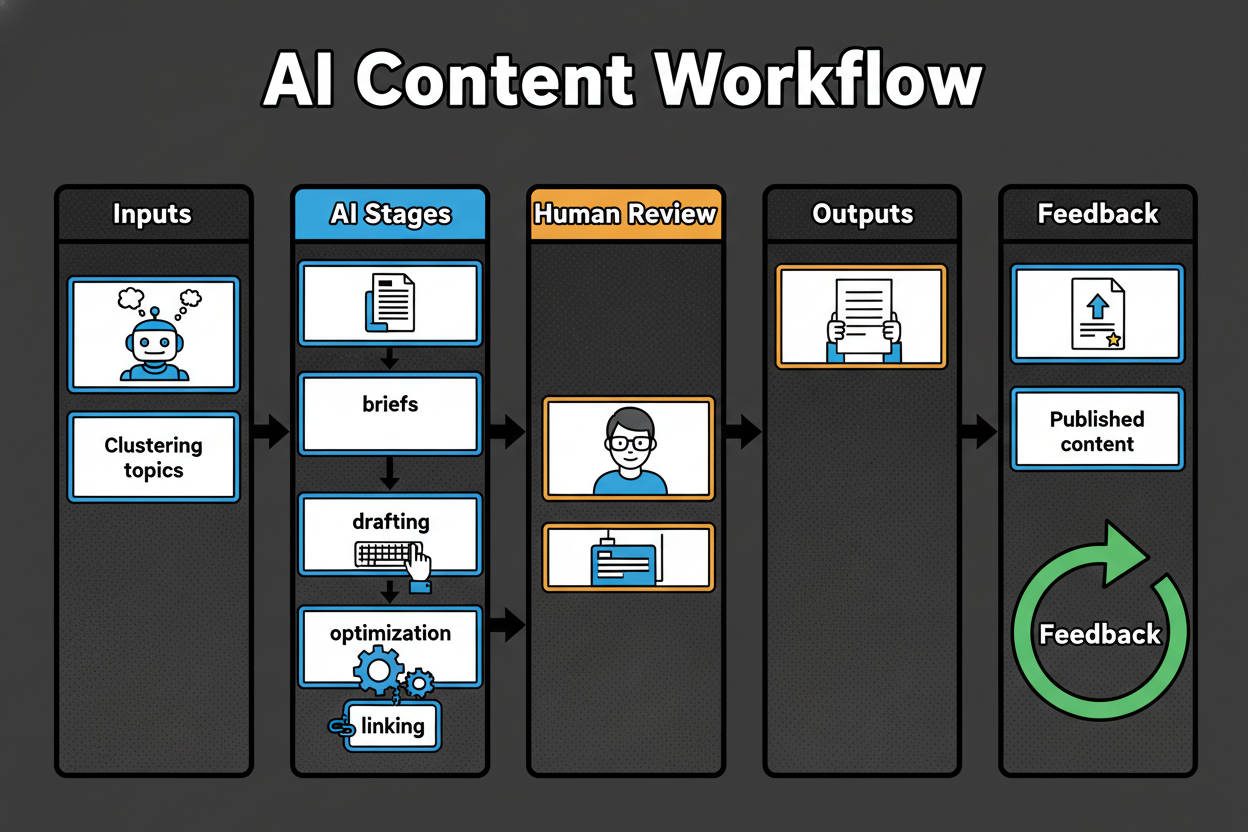
Start with one pilot cluster. Prove the model. Then scale.
Step 1: Define goals, KPIs, and ROI checkpoints
Anchor your ai seo strategy in business outcomes. Choose a north-star metric like qualified organic sessions or pipeline influenced. Establish baselines from GSC/GA4 for the next 30 days. Tag AI-assisted pages in your CMS so you can segment results.
Use a two-level KPI framework. At page level, track time-to-publish, edit distance, on-page optimization score, average rank, CTR, internal link equity received, engagement, and conversions. At program level, track content velocity, topical authority coverage by cluster, SOV, rank distribution, AI Overview visibility, cost per page, and pipeline or revenue.
Tie KPIs to ROI using the SOV method. Forecast and measure ROI as: ROI = (Incremental revenue - total incremental costs) / total incremental costs.
Translate SOV lift into revenue with this path: SOV lift → incremental clicks → conversions → revenue. Calculate baseline SOV, re-check after publishing, estimate incremental clicks from total addressable demand, apply your CVR and value per conversion, then subtract costs. Keep this math in your dashboard so you can defend investment with clarity.
Governance gate: the strategist signs off on goals, hypotheses, and the SOV-to-revenue model before any production starts.
Step 2: Select and connect your AI toolchain
Map requirements to capabilities, not hype. You need research, clustering, optimization, drafting, internal linking, rank and AI visibility tracking, and reporting. Keep it lean in the pilot. A best-of-breed stack usually wins on quality, even if it means a few more tabs open.
Wire data flows. Ingest GSC queries, competitor URLs, and SERP data into your clustering tool. Connect your optimization editor to your CMS for drafts. Route rank and AI visibility trackers into Looker Studio or Power BI for program-level reporting. Set up webhooks or exports to log approvals, publish dates, and approvers.
Governance gate: ops and legal confirm data privacy, originality checks, and compliance rules. No automation goes straight to production in regulated spaces.
Step 3: Model demand and build the content roadmap
Run SERP-based clustering to group queries by intent. Apply thresholds like top-10 overlap to avoid cannibalization. Label each cluster with primary entity, search intent, and page type. Score opportunities by demand, difficulty, and authority fit. This is where ai seo starts paying dividends in planning speed and precision.
Create AI-generated briefs for the top clusters. Include headings, entities to cover, FAQs, competing angles, internal link targets, and schema suggestions. Pull in data from SERPs and competitors to ground the brief in reality, not generic advice.
Human-in-the-loop: the strategist reviews the roadmap and briefs. Resolve mixed-intent clusters, combine duplicates, and call out differentiators and proof you’ll add. This is your moat.
Step 4: Produce, optimize, and interlink
Draft with guardrails. Use brand voice prompts, retrieval-augmented instructions with sources, and an entity checklist. Require an editor voice pass and an SME fact-check for accuracy and examples. Most marketers still edit AI output, which is a feature, not a bug blog.hubspot.com.
Optimize with NLP-driven editors to cover missing entities and structure. Don’t chase scores for their own sake. Match search intent and improve readability. Practitioners warn against over-optimization, so keep judgment ahead of tool grades ibeamconsulting.com.
Now the internal linking automation pattern. Build an entity graph by crawling your site and extracting entities and intent. Use anchor selection rules that mix distributions: roughly 10% exact match, 70% partial and semantic variants, 20% branded or plain anchors. Apply link quotas by length, ensure a pillar link and at least one sibling per page, and enforce no-repeat guardrails globally and per page. Prioritize links from high-authority pages to cluster gaps. Log every suggestion with source, target, anchor, and reviewer.
Human-in-the-loop: SEO approves link batches in staging. Editors sanity-check readability. Never auto-link directly to production for sensitive domains.
Governance gate: originality check, compliance review, and SEO QA (schema, canonicals, indexability) before publish.
Step 5: Publish, measure, iterate
Stage and publish with a tight SLA. Request indexing, verify the canonical, sitemap, and structured data. Then measure on a cadence that fits how search moves.
Weekly, review rank distribution, page-level average ranks, CTR against your expected curve, link equity received on new pages, and content velocity. Monthly, review SOV and AI Overview visibility, conversions, and ROI vs forecast. Use this loop to adapt briefs, add subsections, expand FAQs, and backfill internal links.
When a checkpoint flags issues, pull the troubleshooting playbook. Thin sections and positions 11–20? Expand entity coverage and add 3 to 5 contextual links from high-authority pages. Cannibalization? Consolidate or retarget intents and update internal links. Over-optimized but underperforming? Reduce repetition, add original examples and visuals, and vary anchors. Inaccuracies? Require source-linked retrieval and SME verification. Each symptom has a likely cause and a fix, so you don’t guess twice.
Mini-case study (illustrative example)
Project: Cloud cost optimization cluster Objective: Qualified leads and pipeline Time horizon: 90 days Scope: 24 pages across 1 pillar and 23 subtopics
Baseline
-
Organic sessions: 12,450
-
Average rank: 18.3
-
CTR (weighted): 2.6%
-
Conversions: 210
-
SOV: 6.8% across 120 target terms
-
Content velocity: 3 pages/week
-
Internal link density: 4 per page
-
Time-to-publish: 14 days Intervention
-
AI tactics: SERP-based clustering, AI briefs with entity checklists, NLP optimization, internal linking automation, schema suggestions
-
Tools: research and rank tracking, optimization editor, AI writing assistant, internal linking tool
-
Prompts/guardrails: brand voice rules, retrieval with sources, no-claim-without-citation
-
Human review: strategist roadmap approval, SME fact-check, editor voice pass, SEO QA with link approval
-
Governance: originality check and compliance review pre-publish Execution notes
-
Production cadence: 7 to 8 pages/week
-
Internal linking: entity graph, 10/70/20 anchor mix, link quotas by length, no-repeat guardrails
-
Technical: FAQ and HowTo schema added, template speed improvements
-
Experiments: title and meta variants for top 5 pages Outcomes (90 days)
-
Organic sessions: 18,950 (+52.2%, +6,500)
-
Average rank: 11.4 (up 6.9 positions)
-
CTR (weighted): 4.1% (+1.5 pp)
-
Conversions: 356 (+69.5%, +146)
-
SOV: 12.9% (+6.1 pp)
-
Content velocity: 7 pages/week
-
Time-to-publish: 5 days
-
Internal link density: 12 per page ROI using SOV-based attribution
-
TAD for tracked set: 210,000 searches/month
-
SOV lift: +6.1 pp → incremental clicks = 210,000 x 0.061 = 12,810/month
-
Lead gen CVR: 2.3%; lead value: 180
-
Incremental revenue: 12,810 x 0.023 x 180 = 53,041 per month
-
Costs: tools 900, labor 4,600 → 5,500 total
-
ROI: (53,041 - 5,500) / 5,500 = 8.64 (864%)
-
Confidence: medium, annotated for seasonality and a concurrent email campaign This is illustrative, but it shows how to tie SOV lift to revenue and defend investment.
One-page implementation checklist
- Align goals and KPIs: baselines, north-star metric, SOV-to-revenue model, governance gates.
- Choose a minimal stack: research, clustering, optimization, drafting, linking, tracking, reporting.
- Model demand: SERP-based clusters, labeled by intent and entities, prioritized by opportunity score.
- Create and optimize: AI briefs, brand-guarded drafts, NLP checks, schema, accessibility, SEO QA.
- Automate internal links: entity graph, anchor rules, link quotas, no-repeat guardrails, human approvals.
- Publish and iterate: index checks, weekly rank and CTR reviews, monthly SOV and ROI, playbook-driven fixes.
Integrating AI SEO Tools: Choosing and Using the Right Solutions
Tools can turbocharge your workflow or bury your team in tabs. The trick is matching real needs to clear capabilities, then connecting data and approvals so everything flows.
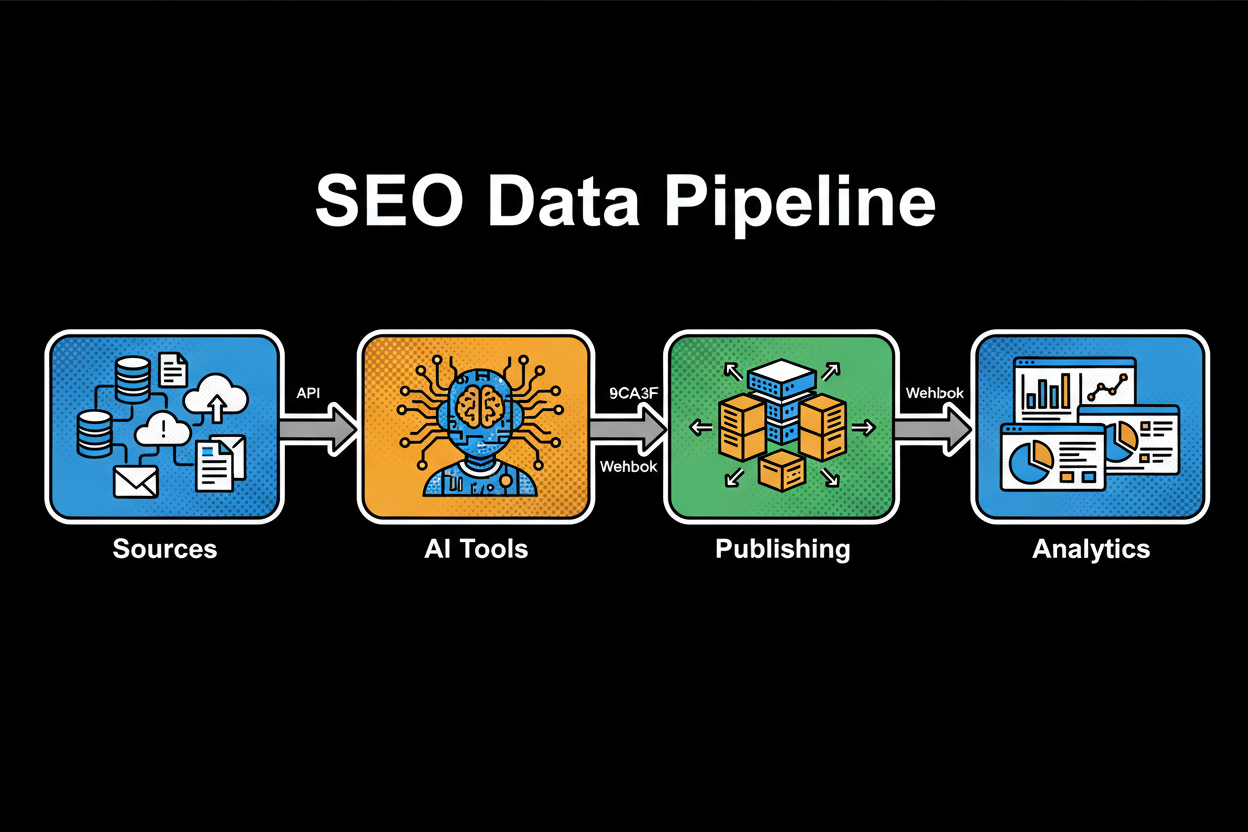
Here’s a pragmatic view of the landscape. Focus on fit-for-purpose, not feature sprawl.
| Category | Representative tools | Primary capabilities | Data sources | Best for | Cautions | Typical price |
|---|---|---|---|---|---|---|
| Keyword research | Ahrefs, Semrush | Keyword volumes, SERP features, competitor gaps | Proprietary index + SERP-based | Market sizing, gap analysis | Estimates vary; learn each tool’s sampling | 99–399/month |
| Clustering/topic modeling | Keyword Insights, LowFruits, Semrush Topic Research | SERP-based clustering, intent groups, briefs | SERP-based | Building hubs and pillars | Over-clustering if thresholds are too strict | 29–99/month |
| Content optimization editors | Surfer, Clearscope, MarketMuse, Frase | NLP entities, content scoring, outlines | SERP-based | On-page optimization | Over-optimization risk; scores aren’t rankings | 60–300+/month |
| AI writing assistants | Jasper, Writer, Copy.ai, ChatGPT | Drafting, rewriting, tone control | Proprietary model | First drafts and variants | Generic output, hallucinations; always edit | 20–200+/seat |
| All-in-one AI SEO | Scalenut, Alli AI, SE Ranking | Research, briefs, optimization, links | Mixed: proprietary + SERP-based | Streamlined workflows | Jack-of-all-trades tradeoffs | 39–300+/month |
| Internal linking automation | Link Whisper, InLinks | Link suggestions, anchor text, knowledge graph | Site crawl | Scaling internal links | Irrelevant anchors if rules are loose | 10–200/month |
| Rank and AI visibility tracking | AccuRanker, Semrush, Ahrefs, Surfer AI Tracker | Daily ranks, AI Overview mentions | SERP-based | Monitoring performance | SERP volatility can skew reads | 49–300+/month |
| Technical audit | Screaming Frog, Sitebulb, Ahrefs Site Audit | Crawl issues, speed, schema | Site crawl | Fixing site health | Requires expertise to prioritize | One-time or 20–200/month |
| Analytics/BI | Looker Studio, Power BI | Reporting, dashboards, blending | GA4, GSC, tool APIs | Executive reporting | Data joins can break if schema changes | Free–enterprise |
A realistic stack for a mid-market B2B team
Say you’ve got 1 strategist, 1 editor, and 2 writers. You need speed without chaos. Pick Ahrefs or Semrush for research and rank tracking. Use Keyword Insights for clustering to get SERP-grounded clusters. Choose one optimization editor like Clearscope or Surfer. For drafting, pick ChatGPT or Jasper with strong brand prompts and retrieval. Add Link Whisper or InLinks for internal link scaling. Track ranks with AccuRanker if you want dedicated depth, and build dashboards in Looker Studio.
Tradeoffs are real. An all-in-one platform like Scalenut simplifies onboarding and can cover research through optimization. But best-of-breed often yields higher-quality briefs and on-page depth. Practitioner communities commonly recommend mixing tools instead of relying on a single suite ibeamconsulting.com.
Pitfalls and safeguards
Governance matters. Add approval gates for originality and compliance. Never push auto-linking or auto-publishing straight to production, especially in regulated spaces. Keep a release log with approvers.
Manage prompts like assets. Standardize brand voice, tone sliders, entity checklists, and retrieval instructions with source requirements. Version your prompt library. When performance drifts, refresh the few-shot examples with current SERP insights.
Avoid over-optimization. Content scoring tools are helpful, but chasing a number can bloat content. Prioritize intent match, readability, and unique value. Be wary of generic drafts from AI writers. Strong briefs, retrieval with sources, and a real editor are non-negotiable.
Integrate lightly. Use APIs or CSV exports to move data into dashboards and CMS staging. Start with a minimal viable stack, then layer integrations where they remove real friction.
You’ve got the stack and the wiring. Next up, we’ll squeeze performance from every stage with advanced ai seo optimization tactics, including clustering nuance, semantic on-page wins, and a refresh engine that protects your gains.
Optimizing Every Stage of SEO with AI: Advanced Tactics and Tips
You’ve got the framework. Now let’s turn the dial from good to compounding.
Think of this as four loops running in parallel: planning, creation, optimization, and measurement. AI speeds each loop, but the magic comes from the handoffs and feedback signals you wire in.
Start with planning that sees around corners. Use SERP-based clustering to map the cluster, but add intent disambiguation passes on ambiguous groups. If two queries share results but mix informational and transactional pages, split the cluster. Label each group with primary entity, intent, and page type. Then assign one page per intent to avoid cannibalization.
Bring in page templates for scale. For every top cluster, define a repeatable page model: structure, headings, expected entities, FAQ count, schema types, and internal link targets. Your AI brief generator should inherit these models so drafts start aligned.
Now, the internal linking system that moves rankings. Build an entity graph that maps every page to its primary and secondary entities and intent. Apply anchor rules that mix distribution by target across the site: roughly 10% exact match, 70% partial or semantic variants, 20% branded or plain anchors. Set quotas by page length, require at least one pillar link and one sibling link, and enforce no-repeat guardrails so no identical exact-match anchor appears more than a handful of times in a rolling window. Prioritize suggestions from high-authority pages to new or underlinked pages. Approve in batches in staging so quality stays tight.
Protect your gains with a refresh engine. Track content decay using moving windows: compare trailing 28 days to the previous 28 and to a 90-day baseline. If impressions and clicks dip beyond a threshold, trigger a refresh brief that flags missing entities, new People Also Ask questions, and competitor adds. Expand sections, update examples, and add fresh internal links. This keeps velocity without chasing new topics for the sake of it.
Watch the new search surfaces. AI-generated results shift often, so monitor visibility and adapt. Ahrefs observes AI Overview content changes roughly every couple of days, with many citations flipping each time ahrefs.com. Track mentions of your brand and URLs with an AI visibility tool, or log them manually if you must. Surfer’s AI Tracker is one option practitioners mention for this job youtube.com. When you are cited, analyze which sentences and sections the AI is pulling. Strengthen those blocks. When you’re not cited, add a concise, 40 to 55 word answer box and a short bulleted steps section near the top, then support it with references and schema.
Design experiments, not guesswork. Titles and meta descriptions drive clicks, so run controlled tests on pages with meaningful impressions. Use GSC to segment queries by intent and measure CTR deltas against expected curves. Add snippet-ready blocks that answer the query directly, then layer schema like FAQ, HowTo, or Product where it fits. Avoid bloating pages just to inflate content scores. Practitioners warn against chasing grades over intent and clarity ibeamconsulting.com.
Here’s a crisp before and after so you can see the compounding effect.
Illustrative before and after: project management templates cluster
- Baseline, 60 days: 9,200 organic sessions, 15.9 average rank, 3.1% weighted CTR, 124 signups, 5.4% SOV across 85 tracked terms.
- Intervention: SERP clustering, AI briefs with entity checklists, AI drafts with retrieval and brand voice prompts, NLP optimization, internal linking automation with 10/70/20 anchor mix and quotas, FAQ and HowTo schema, title/meta tests on top 6 pages, refresh of 3 decaying pages.
- Outcomes, next 60 days: 13,850 sessions (+50.5%, +4,650), 10.8 average rank (up 5.1 positions), 4.6% CTR (+1.5 pp), 211 signups (+70.2%, +87), SOV 10.7% (+5.3 pp).
- SOV-to-revenue attribution: TAD 140,000 searches/month, SOV lift 0.053 → incremental clicks 7,420/month. CVR 1.9%, value per signup 220. Incremental revenue 7,420 x 0.019 x 220 = 31,004/month. Incremental costs 3,900. ROI = (31,004 - 3,900) / 3,900 = 6.95. That is one cluster, two months, and a playbook you can repeat.
Advanced tips checklist
- Gate drafts with AI briefs that include entity lists, target SERP features, and 3 differentiators.
- Approve internal links in weekly batches, then backfill from top pages to new ones.
- Add a direct answer box and 1 short list near the top for your primary intent.
- Track AI Overview mentions and adjust the top 150 words to match intent clarity ahrefs.com.
- Refresh decaying winners before they dip 20%, not after.
- Test titles and meta on pages with at least 1,000 monthly impressions, one variant at a time.
- Use content scoring to catch gaps, not to inflate term density ibeamconsulting.com.
Frequently Asked Questions about AI Powered SEO Content Strategy
Q: Can AI-generated content rank, or is it risky? A: It can rank when it serves the searcher better than what exists. The risk comes from thin, generic, or inaccurate output. Use strong briefs, retrieval with citations, human editing, and SME review to ensure accuracy and E-E-A-T. Most marketers still edit AI output before publishing, which is a good sign you should too blog.hubspot.com.
Q: How do I design briefs and reviews to avoid generic output and hallucinations? A: Start with SERP-grounded briefs: primary intent, must-cover entities, FAQs, examples required, and a POV that differentiates you. Draft with retrieval that links to sources for stats and definitions, then require SME fact-check and an editor voice pass. Add a no-claim-without-citation rule to stop invented facts. If you see drift, refresh prompts with updated SERP insights and new few-shot examples.
Q: Are content scoring tools causing over-optimization? A: They can if you treat scores as goals instead of guides. Use NLP editors to find missing entities and structure gaps. Then stop. If a section reads bloated or repetitive, trim it. Prioritize intent match, clarity, and unique examples. Practitioners repeatedly warn that chasing a number can hurt readability and rankings ibeamconsulting.com.
Q: How do I measure ROI from AI-powered SEO without fooling myself? A: Use share-of-voice as the bridge to revenue. Calculate baseline SOV across a tracked keyword set, then re-calc after publishing to get SOV lift. Translate lift to incremental clicks by multiplying against total addressable demand, apply your conversion rate and value per conversion, subtract incremental costs, and compute ROI. To reduce bias, stagger rollouts, keep control clusters untouched, log other campaigns, and separate brand vs non-brand SOV.
Q: How should I monitor AI-generated search surfaces like AI Overviews? A: Add AI visibility as a KPI. Track whether your pages or brand are cited in AI-generated results and how often that changes. Ahrefs found AI Overview content changes roughly every couple of days, with many citations flipping each time ahrefs.com. Use a dedicated tracker if you have one, like Surfer’s AI Tracker, or log manually with screenshots and dates youtube.com. Adapt by tightening your direct answers, adding concise lists, and strengthening references.
Q: How do I prevent duplication and cannibalization when scaling with AI? A: Cluster by SERP similarity and split mixed-intent groups. Maintain a canonical map that assigns one URL per intent. Enforce internal link rules so links support the chosen canonical target. If you discover overlap later, consolidate content, set redirects or canonicals, and update links to the winner.
Q: What controls keep internal linking automation safe and effective? A: Use an entity graph to propose links, but keep human approval in the loop. Follow a 10/70/20 anchor distribution, set link quotas by page length, and enforce no-repeat guardrails so the same exact anchor does not flood your site. Prioritize links from high-authority pages to new content, and always log source, target, anchor, and position for auditing.
Q: How do I handle content refresh and decay at scale? A: Monitor trailing 28 vs prior 28 day deltas and compare to a 90-day baseline. When drops exceed your threshold, trigger a refresh brief that flags missing entities, new People Also Ask questions, and competitor adds. Expand sections, add fresh examples, and re-inject internal links from top pages. Refreshing a decaying winner is often faster ROI than chasing a new page.
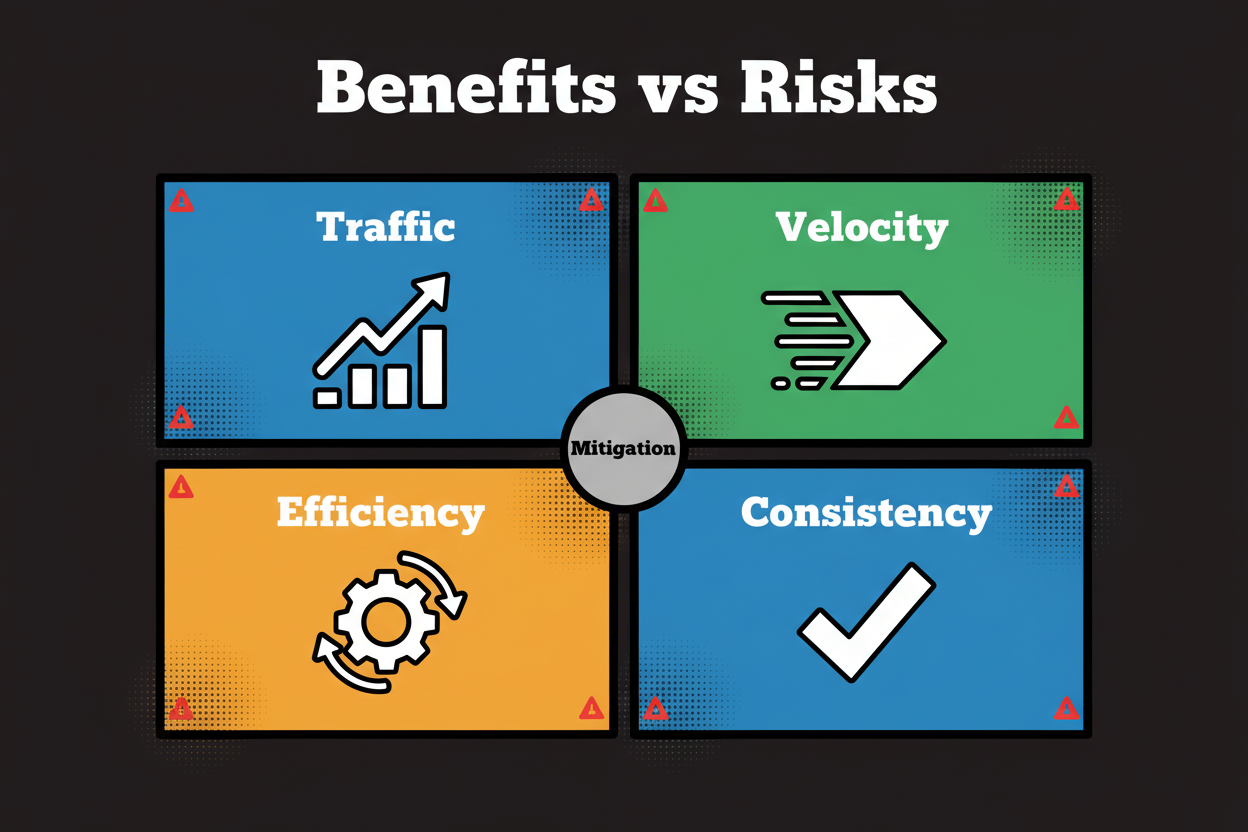
Illustrative mini-case vignette
- Baseline, 45 days: ecommerce accessories cluster at 7,600 sessions, 2.1% CTR, 82 sales, SOV 4.2%.
- Intervention: SERP clustering, AI briefs, AI drafts with retrieval, NLP optimization, internal links with entity graph and quotas, title/meta tests on 4 URLs, FAQ schema on 6 URLs, refresh of 2 decaying category pages.
- Outcomes, next 45 days: 11,200 sessions (+47.4%, +3,600), 3.3% CTR (+1.2 pp), 137 sales (+67%, +55), SOV 8.1% (+3.9 pp).
- SOV-to-revenue: TAD 95,000/month, SOV lift 0.039 → incremental clicks 3,705/month. Conversion 1.7%, AOV 85 → incremental revenue 3,705 x 0.017 x 85 = 5,352/month. Costs 2,100. ROI = (5,352 - 2,100) / 2,100 = 1.55. If you apply the same rigor cluster by cluster, your results compound rather than spike and fade.
Conclusion: Next Steps for Mastering AI Powered SEO Content Strategy
You now have the full system: a workflow that moves from SERP-grounded clustering to AI briefs and guarded drafting, from NLP optimization to a governed internal linking pattern, and a measurement loop that ties SOV lift to revenue. The troubleshooting playbook keeps you out of dead ends, and the refresh engine protects your wins.
Start small. Prove impact on one cluster. Then scale with confidence.
Here are the first three moves to make this week:
- Choose one high-potential cluster and build SERP-based groups with clear intents and page types.
- Create AI briefs for the top 3 pages, draft with retrieval and brand voice, then run NLP optimization and your internal linking rules.
- Set up your dashboard to track rank distribution, SOV, CTR vs expected curves, conversions, and AI Overview visibility. Remember, AI is a force multiplier, not a replacement for your judgment. Most marketers already use AI for content and report it saves hours per piece blog.hubspot.com. The teams that win turn that saved time into better strategy, tighter edits, and faster iteration.
Bookmark this guide. Revisit the frameworks when you add a new cluster, hire a new writer, or switch tools. Your AI Powered SEO Content Strategy will keep improving as your data, prompts, and playbooks get sharper.