Mastering Local SEO with AI: Tactics for Dominating Local Search
Unlock the power of AI for local SEO. Discover actionable tactics, top tools, and proven strategies to boost your local search rankings and attract more customers.
Posted by
 Oleg Kozynenko
Related reading
The Ultimate Guide to AI Powered SEO Content Strategy
Picture this. It’s Monday, 8:30 a.m., coffee in hand. You’re juggling 1,200 keywords in a spreadsheet, opening 11 tabs to compare SERPs, building briefs by hand, and begging teammates for internal link suggestions. By noon, you’ve written… a title. Now flip it. You upload those queries into an AI-orchestrated workflow. It clusters them by search intent, drafts a brief with entities to cover, surfaces internal link opportunities, and flags gaps against competitors. By noon, you’re editing a strong draft and planning the next cluster.
How to Choose the Best AI SEO Tools for Your Content Workflow
Atlas Content had the right people. Smart strategists, solid writers, a reliable dev. But their SEO workflow was stuck in the past. They were juggling keyword research in spreadsheets, copying SERP data into briefs, and manually grading content against competitors. Technical checks lived in a separate crawler export. Monthly reporting took three days and stole time from strategy. Sound familiar?
Streamlining Your SEO Workflow with All-in-One AI Tools
You know the drill. Five tabs open for keyword research, a spreadsheet for mapping topics, a separate crawler, a content editor plugin, and a reporting deck that takes half a day to update. By Friday, you’ve spent more time stitching tools together than actually moving rankings.
Table of Contents
- Why AI is transforming local SEO (and how to win)
- What AI does (and doesn’t) do in local SEO
- AI local keyword research: from guesswork to intent-driven lists
- AI-powered Google Business Profile optimization that moves the map
- AI review management: faster replies, higher trust, better rankings
- Advanced ai local seo: personalization, automation, predictive power
- AI and local SEO: your biggest questions, answered
- Your roadmap to ai local seo success Unlock the power of AI for local SEO. Discover actionable tactics, top tools, and proven strategies to boost your local search rankings and attract more customers.
Why AI is transforming local SEO (and how to win)
You know the feeling. You’re the go-to spot on your block, but a national chain still outranks you in the map pack. Your team is busy serving customers, and the to-do list keeps growing: update Google Business Profile, write posts, answer reviews, track rankings, find local links. It’s a lot.
Here’s the opportunity. AI lets you do the work that moves the needle without burning your week. It spots patterns faster than spreadsheets, drafts content that matches local intent, and surfaces exactly what to fix next. You stay in control. AI just speeds up the right actions.
And the stakes are high. Google’s data shows the intent is real: 76% of people who search for something nearby on their smartphone visit a business within a day, and 28% of those searches result in a purchase thinkwithgoogle.com. Win more of those moments, and everything else gets easier.
You don’t need to guess if AI helps. In a named case, Diggity Marketing documented a 370% increase in monthly AI referral traffic and visibility across 155 keywords in AI Overviews after tightening content and optimizing Google Business Profile positioning diggitymarketing.com. The takeaway is simple: when you align your GBP and content with what searchers want, AI surfaces you more often.
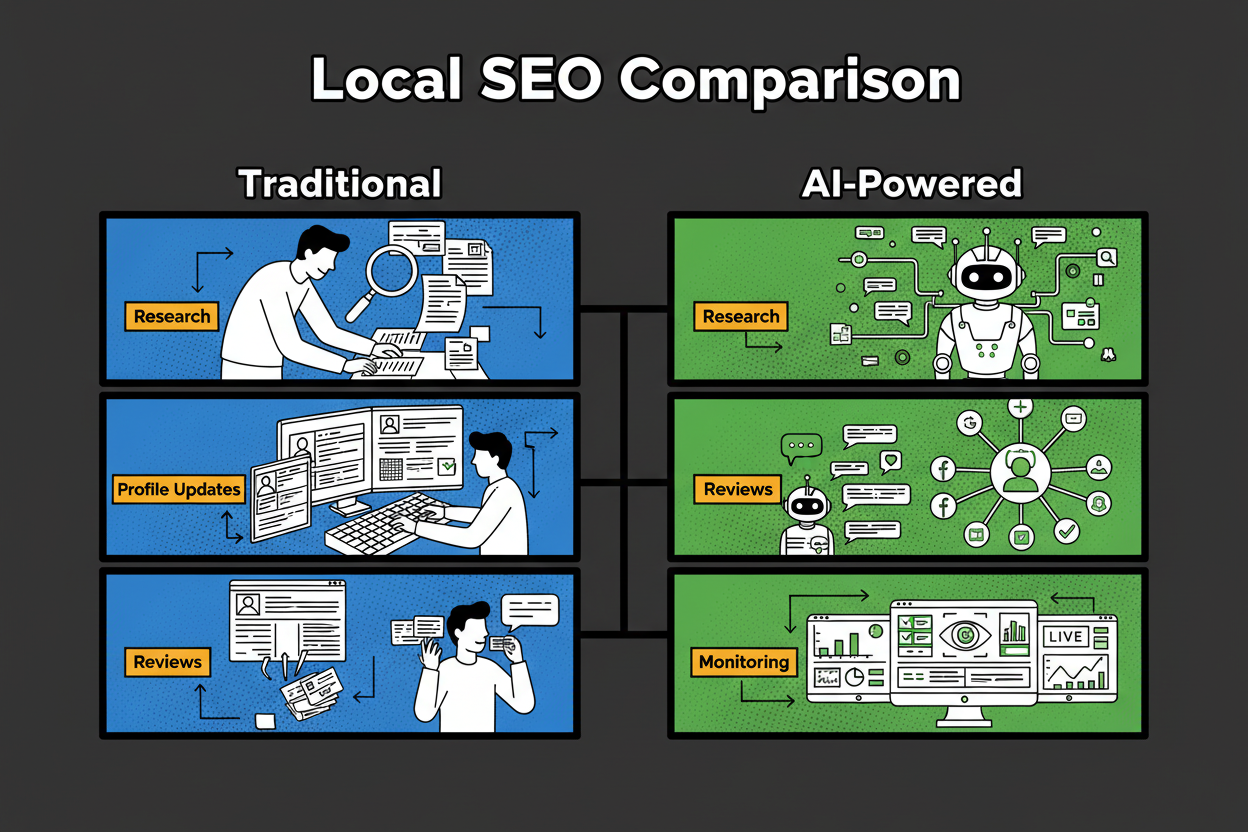
- Audit your Google Business Profile with an AI checklist and fix gaps in categories, attributes, services, and media.
- Automate local keyword research with NLP tools to uncover geo-modified, intent-rich queries.
- Cluster keywords by neighborhood and intent, then map them to pages and GBP posts.
- Generate and optimize local content using AI prompts, then human edit for accuracy and voice.
- Set up AI-powered review monitoring, sentiment analysis, and response templates for fast replies.
- Track rankings with geo‑grid tools and analyze competitors and AI Overview visibility.
- Automate citation building and local link prospecting with AI-assisted outreach.
- Use predictive analytics to spot local trends and time offers and posts.
- Measure ROI in one AI dashboard, tying calls, direction requests, and bookings to actions. That list is your north star. You’ll see exactly how to implement each step, with the prompts, tools, and checklists you can copy. We’ll start by grounding everything in how Google ranks local results, then layer AI strategically so you move faster with more precision.
In the next section, you’ll get a clear picture of what AI actually does in local SEO, how it ties to Google’s ranking pillars, and where humans still make the difference.
What AI does (and doesn’t) do in local SEO
AI is not magic. It’s pattern recognition, language understanding, and workflow automation that helps you cover more ground in less time. In local SEO, that maps to three core jobs: find the right opportunities, execute consistently, and measure what matters.
Google’s official guidance says local results hinge on relevance, distance, and prominence support.google.com. That’s your strategy lens. AI helps you improve all three pillars by making it easier to match searcher intent (relevance), keep your profile and site accurate for your area (distance), and build signals people trust like reviews and local mentions (prominence).
Let’s define AI’s role in plain English. Machine learning spots patterns in big, messy data, like which neighborhoods your rankings drop in or which review themes are trending. Natural language processing (NLP) understands and generates human language, so it can cluster search intent, draft posts, and suggest FAQs that read naturally. Automation runs the boring but important tasks, like posting weekly GBP updates, replying to reviews fast, and syncing citations.
- Machine learning for patterns: trend detection across geo-grids, competitor moves, and review sentiment
- NLP for intent and content: keyword clustering, on-page optimization suggestions, post and FAQ drafting
- Automation for workflows: GBP updates, review replies, citation sync, and scheduled reporting Now tie this to how Google thinks. Relevance improves when your categories, services, and content directly match what locals are searching for. AI helps you spot those intents and keep coverage complete. Distance is mostly user-location driven, but accurate addresses, service areas, and consistent NAP across directories keep you eligible to show up in the right places. Prominence grows with reviews, local links, consistent citations, and user engagement on your profile. AI speeds up all of that work and helps you sustain it.
BrightLocal’s Learning Hub explains these pillars in depth and shows how behaviors like clicks, calls, and direction requests correlate with stronger visibility in the map pack and Finder. It also teaches why keeping categories, attributes, and profile activity fresh matters for relevance and engagement brightlocal.com. Whitespark’s Local Search Ranking Factors page reinforces that GBP elements, on-page relevance, reviews, links, and citations work together, with steady review flow and category accuracy standing out as consistently important levers whitespark.ca.
So how does this look day to day? Picture a “day in the life” when AI is wired into your local SEO.
Overnight, your monitoring flags a competitor that added a new service category. Your system suggests a refined primary category and updates your services list to maintain relevance. It drafts a short GBP description tweak and schedules two fresh photos to publish this week.
In your inbox, there’s a simple briefing: two rising “near me” queries where you’re thin on coverage. A suggested content outline for a location page is ready, based on the top pages in your market, plus four GBP post angles mapped to the same intent.
Your reviews came in while you slept. The AI drafted replies for the positives in your brand voice, highlighted one sensitive case for human approval, and summarized the week’s sentiment: longer wait times on Tuesdays. You forward that insight to your front desk lead.
By lunch, your geo-grid heatmap shows a small slide in one neighborhood. The system recommends a local partnership outreach target based on competitor citations and suggests a community post for the weekend’s event. You click approve. Your reporting dashboard updates with calls, directions, and bookings tied back to the actions you just took.
That’s the point. AI removes the guesswork and the grunt work so you can make better decisions faster. It does the heavy lifting, but you still steer.
AI does not replace your judgment. It can draft an answer, not promise it is right. It can surface a category suggestion, but you need to validate it against Google’s rules and your service mix. It can propose a reply to a negative review, but a human should approve sensitive responses. Keep a human-in-the-loop for anything that affects compliance, brand safety, or customer care.
BrightLocal’s rank tracking guide shows why neighborhood-level visibility is so variable and why you need geo-grid monitoring, not just single-location rank checks brightlocal.com. AI takes the monitoring from monthly to continuous and ties it to actions you can take today.
Here’s how the work itself changes when you plug AI into your stack.
| Task | Traditional Approach | Pain Point | AI-Powered Approach | Time Saved |
|---|---|---|---|---|
| Keyword research | Manual brainstorming and tool exports | Missed local intent and slow iteration | NLP-driven clustering by neighborhood and intent, with competitor gap analysis | High |
| Content creation | Write from scratch, limited by bandwidth | Inconsistent publishing, thin coverage | AI-drafted outlines, posts, FAQs, human-edited for accuracy and tone | High |
| GBP updates | Sporadic edits and photo uploads | Outdated categories/services, low activity | Automated audits, category suggestions, scheduled posts and media | High |
| Reviews | Ad-hoc monitoring and replies | Slow response times, missed trends | Real-time alerts, sentiment analysis, templated replies with human approval | High |
| Citations and links | Manual directory updates and outreach | Inconsistency across listings | AI-assisted citation sync and local prospecting scripts | Medium |
| Reporting | Spreadsheet rollups and snapshots | Hard to tie actions to outcomes | One dashboard tying calls, directions, and bookings to changes | Medium |
| Forecasting | Gut feel and seasonal guesses | Late reactions to trends | Predictive alerts on rising queries and local events | Medium |
One more guardrail before we move on. Google’s official ranking pillars are relevance, distance, and prominence support.google.com. Use AI to improve inputs that influence those pillars: complete GBP info and accurate categories for relevance, precise address and service areas for distance, and sustained reviews, local links, and active profiles for prominence. BrightLocal and Whitespark both emphasize these qualitative levers in their guides and surveys, which is why our playbook focuses on them too brightlocal.com whitespark.ca.
Next, we’ll translate this into step-by-step workflows you can deploy, starting with AI-powered local keyword research that replaces guesswork with intent-driven clarity.
AI local keyword research: from guesswork to intent-driven lists
Local keyword research isn’t a box to tick. It’s the lever that turns high-intent moments into calls and visits. Google’s research shows 76% of people who search for something nearby on their smartphone visit a business within a day, and 28% of those searches result in a purchase. That’s why your keywords must reflect how real people search across your city, not just what you think they type thinkwithgoogle.com.
AI helps you move from random guessing to precise, neighborhood-level intent. Instead of one long list, you’ll build clusters tied to suburbs, service types, and urgency. Then you’ll validate coverage with the SERP and a geo-grid so you know where you actually show up.
Here’s the framework I use to do it fast.
- Listen to the SERP: scan top results to spot intent, questions, and SERP features
- Outlines from competitors via AI: summarize their pages to reveal gaps you can fill
- Cluster by neighborhood/service/stage: group terms by area, offering, and funnel
- Augment with local modifiers: add near me, open now, best, pricing, insurance, same day
- Label intent: informational, commercial local, navigational
- Score by opportunity: weigh volume, difficulty, SERP features, and local revenue value
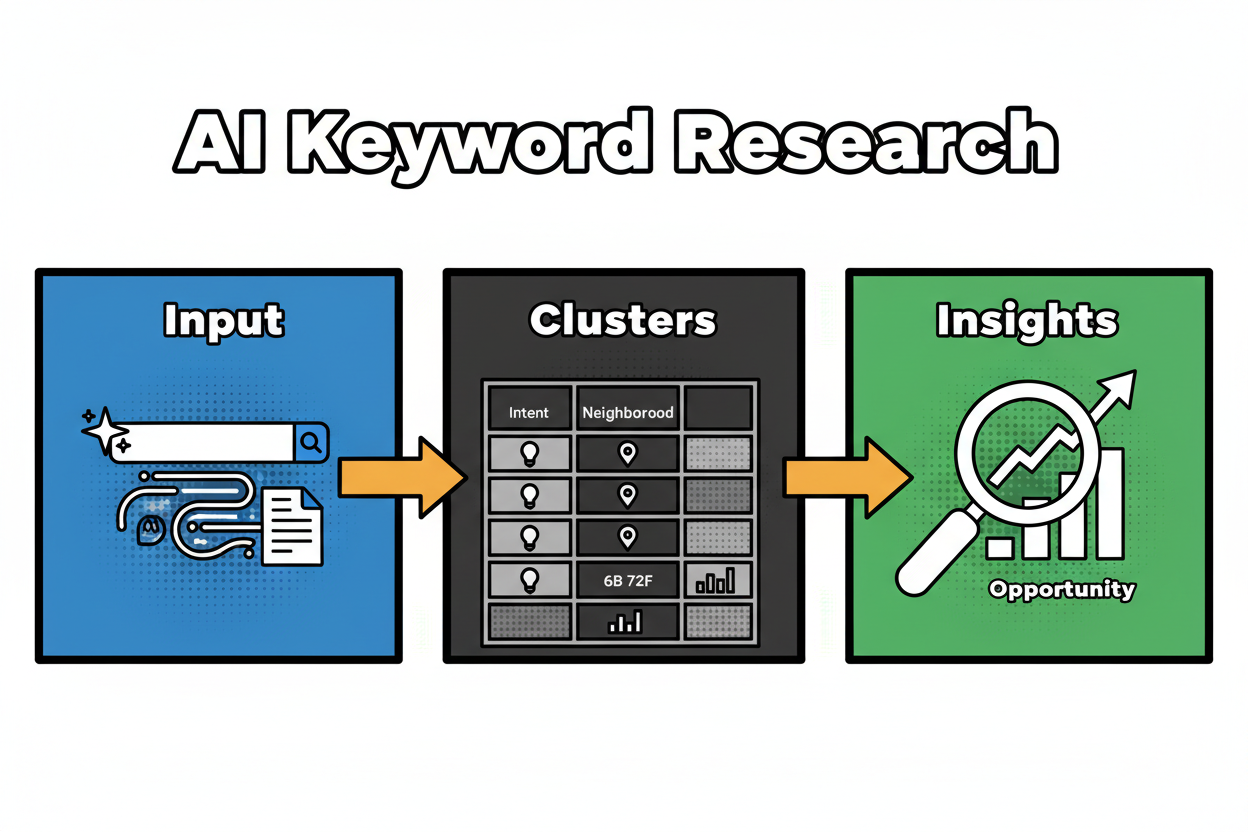
Let’s put this into action. You’ll build a 100-keyword local set in roughly 30 minutes, then pressure-test it by neighborhood.
- Listen to the SERP. Pick one core service, like water heater repair or Invisalign. Search your city plus the service. Note the top-ranking pages, the map pack, People Also Ask questions, and whether the SERP shows images, reviews, or thin directories. You’re extracting intent signals, not copying keywords yet.
- Ask your AI assistant to summarize competitor coverage. Paste the URLs of the top 3–5 local competitors and request an outline: subtopics, FAQs, and missing questions. You’ll quickly see what they repeat and what they ignore. Gaps become your opportunities.
- Generate seeds plus modifiers. Prompt your AI to produce 60–80 queries mixing your service with neighborhood names and urgency modifiers. Keep it simple: “Generate local searches for [service] in [city]. Include neighborhoods and these modifiers: near me, open now, emergency, best, cost, same day, with insurance.” You’ll prune later.
- Cluster by neighborhood, service, and stage. Ask AI to group the list by suburb or zip, then split by service subtype (e.g., repair vs install) and funnel stage (research vs ready-to-book). This is what lets you map to pages, posts, and GBP content that actually matches intent.
- Label intent and content type. Have AI mark each term as informational, commercial local, or navigational. Also ask it to suggest the best content type: location page, service page, GBP post, FAQ, or guide. You’ll use this to assign owners and publishing frequency.
- Score by opportunity. Request a simple 1–3 or 1–5 score for opportunity using difficulty, local volume, and presence of SERP features you can win (map pack, FAQ, reviews). You’re building a lightweight prioritization model.
- Manually validate the top 20. Open the SERP for your top picks and confirm what ranks. If it’s dominated by directories or national blogs, you may need a different angle. Save the terms where local sites and map listings win.
- Check your visibility by neighborhood. Run a geo-grid for 3–5 of your highest-priority terms and see how your rankings change across the city. BrightLocal’s learning hub explains why single-point rank checks can mislead you and why geo-grid or neighborhood-by-neighborhood tracking is the standard for local SEO brightlocal.com. Mark neighborhoods where you underperform.
- Assign terms to assets. Commercial local keywords become service and location pages, plus GBP posts. Questions fuel FAQs on pages and GBP Q&A. Urgent modifiers like open now and emergency get their own GBP posts and short service snippets that highlight availability. Two quick pro tips. First, revisit the SERP monthly for your top clusters. New features and questions appear, and AI can spot the changes faster than you will. Second, keep the geo-grid in your reporting so you know exactly which neighborhoods improve after you ship content or posts brightlocal.com.
Here’s a sample of what your AI-powered output might look like once you’ve validated and prioritized.
| Keyword | Monthly Local Volume | Intent | SERP Features | Difficulty | Priority | Content Type | Geo Modifier |
|---|---|---|---|---|---|---|---|
| emergency dentist cedar park open now | 90 | Commercial local | Map Pack, Reviews | Medium | High | GBP Post + Service Snippet | Cedar Park |
| water heater repair round rock | 150 | Commercial local | Map Pack, PAA | Medium | High | Service Page + GBP Post | Round Rock |
| drain cleaning austin near me | 200 | Commercial local | Map Pack, PAA, Local Ads | Medium | High | Location Page + GBP Post | Citywide |
| best pediatric dentist north loop | 70 | Informational | Reviews, Top Stories | Medium | Medium | Listicle/Guide + FAQ | North Loop |
| same day ac repair south lamar | 110 | Commercial local | Map Pack | Medium | High | Service Page + GBP Post | South Lamar |
| dentist that takes delta dental mueller | 60 | Commercial local | Map Pack, Reviews | Medium | Medium | Service Page + FAQ | Mueller |
| tooth extraction price east austin | 80 | Informational | PAA, Reviews | Medium | Medium | FAQ + Pricing Guide | East Austin |
| 24 hour plumber westlake | 120 | Commercial local | Map Pack, Reviews | High | High | Emergency Page + GBP Post | Westlake |
A quick mini example. A clinic used this process to uncover an “emergency dentist [suburb] open now” cluster it had never targeted. They wrote a short emergency services snippet with hours and insurance info, added a dedicated GBP post per suburb, and saw their map pack coverage expand on the geo-grid in those zip codes within a few publishing cycles. The key wasn’t magic. It was matching urgent intent with the right asset and validating progress by neighborhood.
You can do this in any niche. Start with one service, one suburb cluster, and one urgent modifier. Build the list with AI, validate with the SERP and a geo-grid, then publish. Rinse, repeat, expand. That’s ai local seo turning intent into visits, one neighborhood at a time.
AI-powered Google Business Profile optimization that moves the map
Your Google Business Profile sits at the center of local visibility. Google’s own guidance says local rankings lean on three pillars: relevance, distance, and prominence support.google.com. Your job is to make your profile complete and consistently active so you match more searches (relevance), show accurately where you serve (distance), and earn signals people trust like reviews and local engagement (prominence).
BrightLocal’s learning hub reinforces why categories, attributes, services, and regular updates matter. They shape relevance and drive the clicks, calls, and direction requests that correlate with stronger local visibility brightlocal.com. And complete, polished profiles are more trusted and more likely to drive visits and purchases, which aligns with what local shoppers do next chatmeter.com.
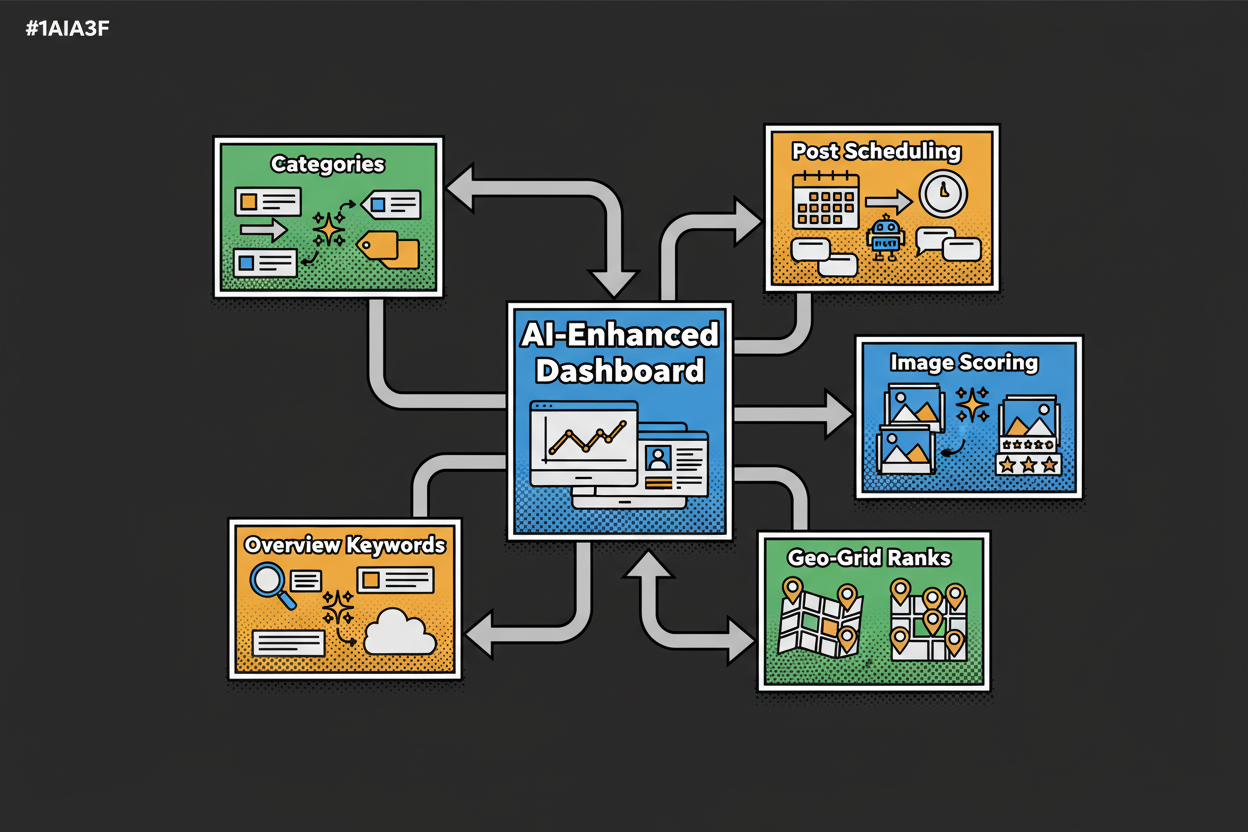
Use this PROFILE framework to optimize GBP with AI and keep it fresh without adding hours to your week.
- Prepare: audit every field and fix NAP consistency across the web
- Refine: pick the best primary and secondary categories using AI suggestions and competitor comparisons
- Optimize: draft descriptions, services, and FAQs with AI prompts, then human edit
- Feed: add high-quality photos and short videos on a steady cadence
- Interact: publish Posts and populate Q&A regularly with AI-drafted ideas
- Link: add UTM parameters to every GBP button (Call, Website, Booking)
- Evaluate: review Insights and iterate on what earns clicks, calls, and requests
| Element | AI Task | Recommended Tools | Metric Tracked | Frequency |
|---|---|---|---|---|
| Categories | Suggest primary + secondary based on competitors and services | AI assistant + manual review | Impressions in relevant queries | Quarterly |
| Description | Draft 750-character benefit-led copy with local keywords | AI assistant + human edit | Profile views, call clicks | Semiannual |
| Services | Generate comprehensive list with variations and pricing notes | AI assistant + manual verification | Service impressions | Quarterly |
| Attributes | Propose applicable attributes by niche | Manual selection | Query matches for attributes | Quarterly |
| Photos/Videos | Select best images, suggest shot list and cadence | AI scoring tool or internal rubric | Photo views, profile engagement | Monthly |
| Posts | Ideate weekly offers, events, and tips mapped to keywords | AI calendar + human edit | Post views, clicks | Weekly |
| Q&A | Draft answers to top questions; seed key FAQs if allowed | AI draft + human approval | Q&A views, keyword matches | Monthly |
| UTM Links | Append and standardize UTM tags for all CTAs | Analytics/UTM builder | Attributed calls, site clicks | One-time + checks |
| Insights Review | Summarize top queries, actions, and neighborhoods | Dashboard + AI summary | Calls, directions, website clicks | Monthly |
Now let’s walk through an example so you can see how it fits together.
Start with a full audit. Confirm your business name, address, phone, hours, and website match across your site and major directories. Inconsistency confuses both users and algorithms. Fix those first so distance and eligibility are clear support.google.com.
Next, refine categories. Ask your AI assistant to scan top competitors’ categories and propose a primary and up to a handful of secondaries that best fit your actual services. Keep a human in the loop here. Mislabeling can hurt more than help. Confirm each category’s definitions and make sure you truly offer the service brightlocal.com.
Optimize your core content. Prompt AI to draft a concise, benefit-led description in your voice. Include one or two service keywords and a clear call to action. Then populate services with specific names users search for and any pricing notes you’re comfortable sharing. Use AI to generate a first pass of FAQs based on the queries you saw in your research, then edit for accuracy and policy. Sensitive answers, like refunds or medical guidance, should always be reviewed by a knowledgeable human.
Feed the profile consistently. Create a simple media playbook: exterior, interior, team, product, before/after, and community shots. Have AI score images for clarity and variety or at least keep a checklist so you don’t repeat the same angle 10 times. Schedule one to two uploads per week to signal activity and keep your visuals fresh brightlocal.com.
Interact with Posts and Q&A. Use your keyword clusters to seed four weeks of post topics that map to commercial intent and seasonal events. Keep them short, visual, and action focused. For Q&A, answer real questions quickly and consider adding helpful, policy-compliant FAQs if the community feature allows. Again, human approval is required for anything sensitive or regulated.
Link everything with UTMs. Add UTM parameters to your GBP website, appointment, and call tracking links so you can attribute clicks, calls, and bookings in analytics. This closes the loop from impression to outcome and tells you which content actually drives action.
Evaluate and iterate. Each month, review Insights to see the queries that triggered your profile, plus calls, website clicks, and direction requests. Cross-check neighborhoods where you lag with a geo-grid for priority keywords, then adjust posts and content to shore up coverage brightlocal.com. You can also watch AI Overviews and competitor moves to catch new opportunities your site or profile should cover, a tactic that’s helped brands increase visibility across AI surfaces diggitymarketing.com.
What does this look like in results? First Rank SEO shared a case where comprehensive GBP optimization led to a sharp rise in mobile impressions and steady gains to #1 positions across target keywords over time firstrank.ca. It lines up with what users expect: complete profiles are perceived as more reputable and are more likely to drive visits and purchases chatmeter.com.
A few guardrails. Always keep a human in the loop for category changes, compliance-heavy FAQs, and negative review replies. Don’t stuff keywords into your business name or misrepresent services. Focus on clarity and completeness. That’s what improves relevance, supports prominence, and turns impressions into action support.google.com.
Stick to PROFILE, and your GBP becomes an always-on acquisition asset. Pair it with AI keyword research and neighborhood-level tracking, and you’ll know exactly where to double down next.
AI review management: faster replies, higher trust, better rankings
Reviews aren’t just social proof. They’re a visibility signal. Google’s guidance says local rankings hinge on relevance, distance, and prominence, and reviews directly feed prominence. Responding shows engagement, which also helps your standing with customers and searchers alike support.google.com.
Here’s the reality: most teams want to reply fast and learn from feedback, but the volume is relentless. AI helps you scale without sounding robotic, and it keeps you on top of trends that actually improve your service. You stay in control. AI handles the heavy lifting.
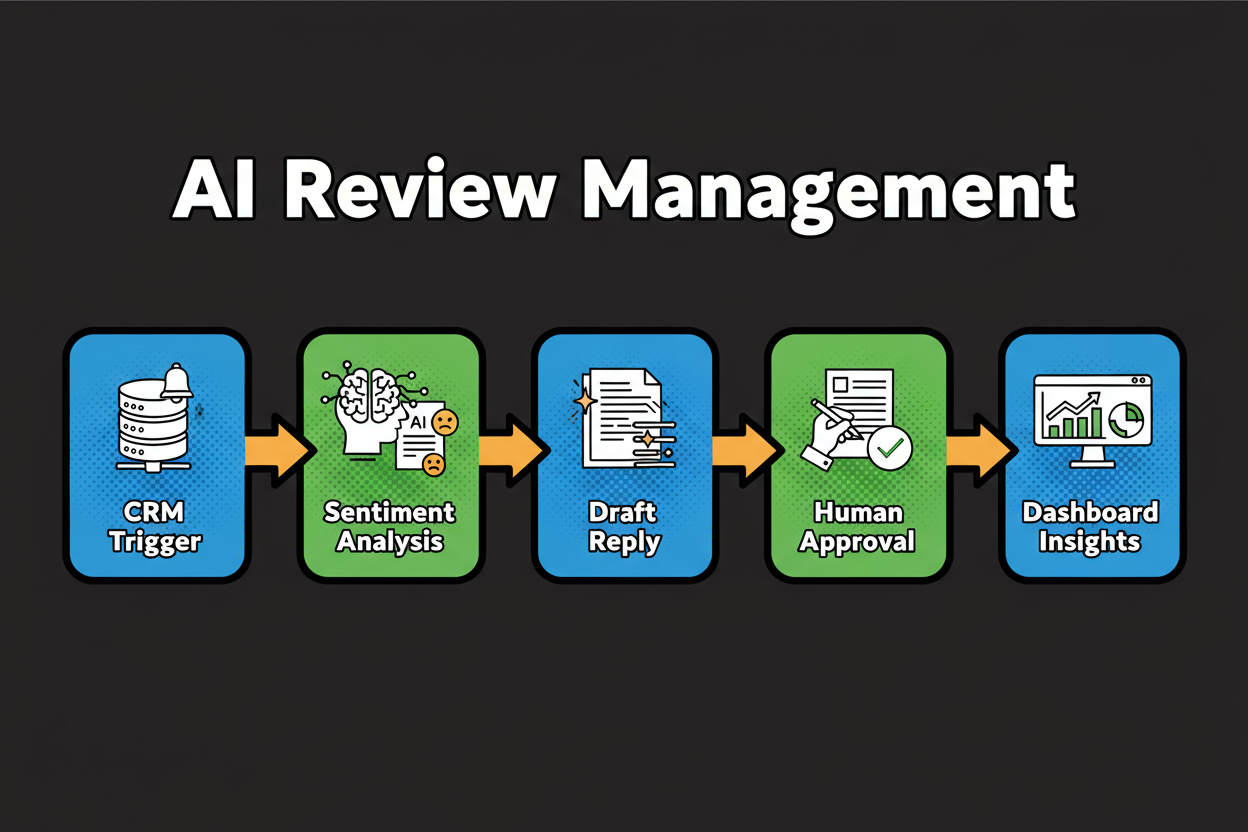
Use this A.C.T. framework to turn reviews into a growth engine.
- Automate review requests via CRM/POS triggers.
- Classify sentiment and themes; route urgent issues.
- Tailor reply tone and content with brand guardrails; publish within SLA. Let’s make it operational. First, connect your CRM or POS so completed jobs, closed tickets, or funded deals automatically trigger a review request. Keep asks simple and timely. Text within a few hours, then a single reminder if there’s no response.
Next, centralize incoming reviews from Google and other major platforms. The AI parses each review, identifies sentiment and themes (staff, wait times, quality), and flags urgent issues. Set clear rules: any review at 3 stars or below, or any review mentioning safety, billing, or compliance keywords, gets escalated immediately.
Response speed matters for reputation and customer trust. A good baseline SLA is to publish replies within 12 hours for positive and neutral reviews, and within 2–4 hours for negative or sensitive ones. AI drafts replies in your approved brand voice. Humans approve sensitive replies before publishing. That balance keeps quality high and risk low.
When SLAs are stable, turn insights into action. Monthly, roll up sentiment themes to spot what’s driving praise or complaints. Share wins with the team. Fix issues at the root. This is where ai local seo moves beyond replies and into real operational improvement.
| Step | Trigger | AI Action | Human-in-the-Loop | SLA | Outcome Metric |
|---|---|---|---|---|---|
| Request review | Job closed / deal funded | Send SMS/email ask; schedule 1 reminder | Marketing sets copy and cadence | Same day | Request-to-review rate |
| Ingest review | New review detected | Parse platform, rating, and content | None for standard routing | Real time | Intake latency |
| Classify | Any new review | Sentiment and theme tagging; risk keywords | Route flagged items to owner | Minutes | % reviews tagged correctly |
| Draft reply | Positive/neutral | Generate branded reply with specifics | Spot audit by manager | 12 hours | Avg response time |
| Escalate | ≤3 stars or flagged terms | Draft empathetic reply; propose offline path | Mandatory approval by lead | 2–4 hours | First-contact resolution |
| Publish | Approved reply | Post to platform; log outcome | Optional final check | Within SLA | Response rate |
| Learn | Weekly/monthly cycle | Aggregate themes and NPS; surface trends | Leadership reviews actions | Monthly | Star avg, repeat issues, CSAT |
This approach isn’t theory. A national mortgage lender implemented an AI-powered review workflow with CRM-triggered requests and centralized responses. The program drove 3,800 new reviews in 10 months, held a 4.9-star average, and increased response rates by 14% after they connected Birdeye with their customer platform and used AI to help triage and reply at scale birdeye.com totalexpert.com. The kicker was what happened inside the business: leadership reviewed AI-generated insights every month, then adjusted processes where friction showed up most.
A few guardrails keep your brand safe. Never fully automate negative or sensitive replies. Use human approval for anything that hints at safety, legal, medical, or financial implications. Keep brand voice controls tight, and avoid promises, pricing specifics, or policy changes in public replies. If the AI drafts something you wouldn’t say face-to-face, change it.
When you close the loop from review to insight to service change, your star average improves, response times drop, and customers notice. That momentum feeds prominence and boosts your local visibility over time, which is exactly what Google’s guidance asks you to earn support.google.com.
Advanced ai local seo: personalization, automation, predictive power
Once your foundations are working, advanced AI helps you do two things your competitors can’t: personalize by neighborhood and act before the trend hits. That’s where automation and predictive models shine. You’ll tailor offers by zip, keep an eye on geo-grid shifts, and cover informational gaps that influence AI surfaces.
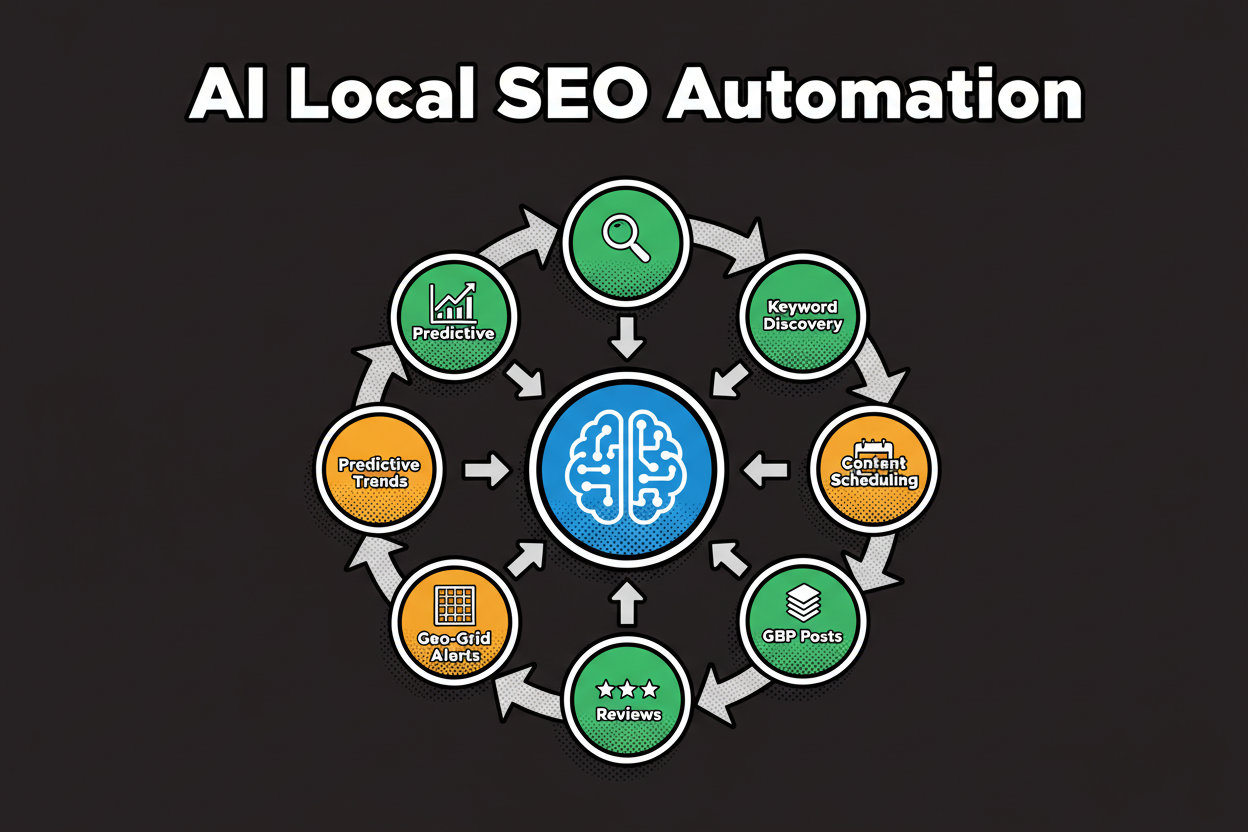
Here’s a practical way to think about advanced tactics. Use the PREDICT framework to build a system that learns, adapts, and compounds.
- Pattern-detect seasonal and neighborhood trends.
- Recommend hyper-local offers and dynamic content.
- Elevate citations and links with AI-assisted prospecting.
- Diagnose rank drops by grid and category changes.
- Influence AI Overviews by covering informational gaps.
- Calibrate budgets to neighborhoods with best ROI.
- Track, test, and tune continuously. Pattern-detect means you’re watching how search demand and engagement shift by week, weather, and event. AI spots when “emergency plumber near me” spikes in a specific zip after a storm. It also sees when a competitor quietly adds a new service and starts picking up calls in your backyard.
Recommend is where personalization kicks in. Draft GBP posts and on-site banners that speak to a neighborhood’s needs right now. For a dental group, that might mean a back-to-school checkup offer in one area and a financing message in another. Keep the brand voice consistent, but let the content flex by location.
Elevate your authority with smarter prospecting. AI can analyze your competitors’ local backlinks and citations, then suggest partners you haven’t considered: community associations, local media, sponsorships that actually align with your service lines. Outreach templates get you started, but your team builds the relationships.
Diagnose rank drops with precision. Geo-grid alerts show exactly where your coverage weakened. Maybe a category update narrowed your relevance, or a new listing started siphoning clicks. AI helps isolate likely causes and recommends moves: category check, fresh photos, updated services, or a hyper-local post that matches the query trend.
Influence AI Overviews by covering informational gaps. When AI-powered panels appear for your services, they tend to cite sources that thoroughly answer common questions. Brands that intentionally fill those gaps with clear content and aligned GBP signals see meaningful lifts in AI referral traffic and more frequent appearances in AI surfaces diggitymarketing.com. Another program expanded from zero to many AI Overviews and saw large growth in AI-driven traffic by systematically targeting those panels with comprehensive, trustworthy content thesearchinitiative.com. The play is straightforward: identify the questions AI shows, answer them better, and ensure your GBP and website reinforce each other.
Calibrate budgets by neighborhood performance. If one cluster yields more calls and direction requests per impression, shift content, post frequency, and even local ad spend there. Then expand what works to adjacent areas.
Track, test, and tune is the glue. Build a weekly rhythm where the system suggests small bets, you review and approve, and outcomes roll back into the model. This is how ai local seo compounds.
| Tactic | What AI Does | Tooling | Risk Check | KPI to Watch |
|---|---|---|---|---|
| Pattern-detect | Spots rising queries, weather/event effects by zip | Trend analysis + geo-grid tracker | Validate anomalies before acting | Query growth by neighborhood |
| Hyper-local content | Drafts neighborhood-specific posts/offers | LLM + content scheduler | Brand voice guardrails | Post engagement, calls |
| Citation/link lift | Finds local partners and coverage gaps | Prospecting assistant | Vet partners; avoid low-quality sites | New local links, referral traffic |
| Grid diagnostics | Flags rank drops; suggests fixes | Geo-grid monitor | Confirm category/attribute changes | Coverage radius, top-3 pin count |
| AI Overview coverage | Surfaces informational gaps to fill | SERP research + content planning | Fact-check; avoid speculation | AI referral traffic, panel mentions |
| Budget calibration | Recommends spend by neighborhood ROI | Performance dashboard | Avoid overfitting short-term spikes | Calls per impression, CPA |
| Continuous tuning | Runs small tests; feeds results back | Experiment tracker | Document learnings, rollback plan | Win rate of tests, time to impact |
A few named examples to ground this. One program documented broad visibility across AI Overviews and a significant lift in AI referral traffic after aligning content with the questions AI panels display and tightening GBP alignment to those topics diggitymarketing.com. Another went from no AI panel presence to strong coverage across many queries and saw large, sustained growth in AI-driven traffic by systematizing gaps and closing them with authoritative content thesearchinitiative.com. The thread is consistent: when you create genuinely helpful, complete answers that match what AI is trying to surface, your brand appears more often.
Now the guardrails. Avoid generic AI content that could fit any city or business. Add local facts, staff names, real photos, and specifics. Keep brand voice controls tight so tone stays human. Maintain a human-in-the-loop for anything sensitive: medical, legal, financial, or policy-heavy claims. Monitor for bias in generated text and align with platform policies. If a tactic feels like a shortcut, it probably is. Prioritize clarity, accuracy, and usefulness.
Advanced tactics aren’t about flashy hacks. They’re about building an always-on system that reads local signals, adapts your message by neighborhood, and helps you show up where customers already look. Keep PREDICT running, and you’ll stay a step ahead while competitors are still reacting. Next, we’ll answer the most common questions teams ask when they start weaving AI into their local playbook.
AI and local SEO: your biggest questions, answered
You asked smart, practical questions across the community. Let’s tackle them head-on, with clear steps and sources you can trust.
Q: What’s the smartest way to start using AI for local SEO if I have one location and a small budget? r/LocalSEO Start with your Google Business Profile and reviews. Those two feed Google’s pillars of relevance, distance, and prominence, so improvements there move the map fastest support.google.com. Use AI to audit missing fields, suggest better categories, draft a tighter description, and plan four weeks of Posts. Then set up AI-assisted review monitoring so you reply fast and learn from sentiment.
Run a simple measurement loop. Watch calls, website clicks, and direction requests in GBP Insights each week, and validate neighborhood coverage with a geo-grid approach instead of a single rank check brightlocal.com. Keep publishing one page or Post per week based on the keyword clusters you uncovered. Local intent converts, so even small gains matter: many searchers visit within a day and a sizable share purchase after local searches thinkwithgoogle.com.
Q: Which AI tools actually help with Google Business Profile optimization, and how do I use them without mistakes? r/LocalSEO Use an AI assistant to compare competitor categories, then pick the most accurate primary and a few relevant secondaries. Categories drive relevance, so validate every suggestion against what you truly offer and Google’s definitions support.google.com. Have AI draft a 750‑character description, a complete services list, and weekly post ideas aligned to your keyword clusters. Add UTM tags to GBP buttons so you can attribute actions.
Watch your Insights. If posts aligned to “emergency” or “open now” queries correlate with more calls, keep that cadence. BrightLocal’s guidance shows why engagement and activity support visibility, and why ongoing category and attribute checks matter brightlocal.com. In one program, tightening GBP fundamentals drove strong gains in mobile impressions and top positions over time firstrank.ca.
Q: Can AI replace a human local SEO specialist, or is it just a way to work faster? r/SEO AI accelerates research, drafting, and monitoring at scale. It doesn’t replace strategy, compliance, or relationship-driven work. Humans still decide priorities, validate categories, oversee sensitive review replies, and build local partnerships that earn real links and citations. Google’s pillars require accurate inputs and authentic engagement more than ever support.google.com. Use AI as your force multiplier. Keep a human in the loop for judgment calls, brand voice, and anything regulated.
Q: Is it safe to use AI to draft Google review responses? How do you keep replies authentic? r/LocalSEO Yes, with guardrails. Let AI draft varied, specific replies in your voice to speed up response time, which helps both customers and visibility. Route 1–3 star reviews or those mentioning safety, billing, or compliance terms to a human approver. That balance works: a national lender used an AI‑assisted workflow to earn thousands of new reviews, maintain a high star average, and lift response rates by double digits while leadership reviewed insights monthly birdeye.com totalexpert.com. Reviews feed prominence, and responding signals engagement support.google.com.
Q: How do AI Overviews affect local visibility, and can a small business influence them? r/SEO AI Overviews tend to cite sources that directly answer common questions comprehensively. You can influence inclusion by publishing clear, trustworthy answers on your site and aligning your GBP content to those topics. Teams that targeted informational gaps and tightened GBP saw big gains in AI referral traffic and more frequent AI citations across many queries diggitymarketing.com thesearchinitiative.com. Track which questions surface in AI panels, then answer them better, with facts and local proof points.
Q: Can AI help with local keyword research at the neighborhood level? What’s the setup? r/LocalSEO Absolutely. Use AI to generate geo‑modified queries by neighborhood and intent, then cluster them by service and urgency. Validate the top terms with manual SERP checks and a geo‑grid so you see where you actually rank across the city brightlocal.com. Map commercial terms to service or location pages plus GBP Posts, and push FAQs for informational questions. Local intent is high‑value, so even small lifts translate into more visits and purchases thinkwithgoogle.com.
Q: How do I measure ROI from AI‑driven local SEO? What metrics prove it’s working? r/LocalSEO Tie actions to outcomes with a tight analytics stack. UTM‑tag your GBP CTAs, then monitor:
- Calls, direction requests, and website clicks in GBP Insights
- Geo‑grid coverage by neighborhood for priority terms
- On‑site conversions from local pages If local actions rise after category improvements, new Posts, or a location page launch, you’re on track. To estimate revenue impact, layer in the strong visit and purchase behavior from local intent research thinkwithgoogle.com. BrightLocal’s methodology explains why neighborhood‑level tracking is essential for accurate reporting brightlocal.com.
Q: What are the biggest risks of automating local SEO with AI, and how do I avoid them? r/SEO Three stand out. First, generic or inaccurate content hurts trust. Always localize with real details and proof. Second, category mistakes or misleading GBP fields can reduce relevance or violate policies, so validate every change support.google.com. Third, fully automated review replies can mishandle sensitive issues. Use AI for drafts, but keep mandatory human approval for negatives or policy topics. Run brand voice guardrails and avoid promises, medical/legal advice, or pricing commitments in public replies.
Q: Do AI‑generated GBP Posts actually move rankings or drive real actions like calls and directions? r/LocalSEO Posts support relevance and engagement, which feed prominence over time support.google.com. The key is alignment. When Posts match high‑intent local keywords and seasonal needs, you’ll see more clicks and calls in Insights. Complete, polished profiles are also perceived as more reputable and tend to earn higher visit and purchase rates, which reinforces the cycle chatmeter.com. Programs that committed to steady GBP optimization saw strong lifts in impressions and top positions, making Posts a valuable part of the mix firstrank.ca.
Q: How do multi‑location brands scale AI local SEO without losing authenticity? r/SEO Standardize your frameworks and voice, then localize the facts. Use shared prompts and templates for keyword clustering, GBP content, and review replies, but insert location‑specific details like neighborhoods, team names, and local events. Centralize monitoring and insights, yet route sensitive items to local managers for approval. Keep per‑location UTM tracking and review acquisition so you can see what’s working by market brightlocal.com. AI helps you scale, while humans protect brand and context. That pairing is how reputation programs earned big gains in reviews and response quality without sounding robotic birdeye.com.
Q: What metrics matter most for ai local seo success? r/LocalSEO Anchor on what customers actually do. Calls, direction requests, and website clicks from GBP. Geo‑grid coverage for priority terms by neighborhood. Review volume, recency, and response time. Organic conversions on local pages. If you’re improving those while your GBP stays complete and accurate, you’re earning relevance, prominence, and trust the right way support.google.com brightlocal.com. Keep these in one dashboard and review them weekly so you can adjust fast.
That’s the play. Use AI to find the right opportunities, execute consistently, and measure what matters. Keep people in the loop where judgment and care are required. The result is compounding visibility and more customers from nearby searches.
Your roadmap to ai local seo success
AI turns local SEO from a scattered to-do list into a tight system you can run every week. You’ve seen how to use LOCALS to uncover neighborhood intent, PROFILE to keep your Google Business Profile complete and active, A.C.T. to reply fast and learn from reviews, and PREDICT to personalize and act ahead of trends.
The pattern is simple. Use AI to find what matters, publish with intent, respond with empathy, and measure everything. When you tie actions to outcomes like calls, direction requests, and bookings, your visibility compounding is no accident. It’s the result of a modern ai seo strategy executed consistently.
You don’t need to overhaul everything at once. Start with one service and one neighborhood, get a quick win, then scale the workflow across your footprint. That’s how you dominate the map and every high‑intent surface that follows.
Summary of AI tactics and benefits
| Tactic | Primary Benefit | Core Tools | Typical KPI Lift |
|---|---|---|---|
| LOCALS (AI keyword discovery and clustering) | Maps real local intent by neighborhood to pages, posts, and FAQs | LLM assistants, SERP analyzers, local rank trackers | +10-30% more calls from high‑intent terms; better geo‑grid coverage |
| PROFILE (AI‑assisted Google Business Profile optimization) | Stronger relevance and engagement from complete, active profiles | GBP manager, image scoring, post scheduler, analytics | +15-40% growth in calls, direction requests, and profile clicks |
| A.C.T. (Automate, Classify, Tailor review workflow) | Faster, authentic replies and steady review flow that boost prominence | Review platforms with AI replies and sentiment, CRM triggers | Response time under 12h; +10-25% review volume; steadier star average |
| PREDICT (advanced automation and forecasting) | Anticipates demand, personalizes by zip, and closes informational gaps | Trend monitors, content planners, automation hubs | +10-35% lift in actions during seasonal spikes; faster recovery from rank dips |
| Geo‑grid monitoring and alerts | Pinpoints wins and drops by neighborhood to focus effort | Geo‑grid rank trackers, competitor watchers | Wider top‑3 radius; earlier detection of local rank shifts |
| AI Overview coverage targeting | Earns citations and traffic from AI panels by answering key questions | SERP research, content gap analysis, LLM drafting | Noticeable AI referral traffic; more frequent AI panel mentions |
| Citation and local link automation | Builds consistent NAP signals and local authority at scale | Listings managers, citation builders, AI outreach scripts | Fewer NAP inconsistencies; new local links; stronger prominence signals |
| UTM attribution and ROI dashboard | Ties posts, pages, and replies to calls, clicks, and bookings | Analytics with UTM standards, GBP Insights, BI dashboards | Clear cost‑per‑call and cost‑per‑direction; confident budget shifts |
Schema markup for this guide
{
"@context": "<https://schema.org>",
"@type": "Article",
"headline": "Mastering Local SEO with AI: The Ultimate Guide to Dominating Local Search",
"description": "Unlock the power of AI for local SEO. Discover actionable tactics, top tools, and proven strategies to boost your local search rankings and attract more customers.",
"url": "<https://yourdomain.com/blog/ai-local-seo-guide>",
"mainEntityOfPage": {
"@type": "WebPage",
"@id": "<https://yourdomain.com/blog/ai-local-seo-guide>"
},
"author": {
"@type": "Organization",
"name": "Your Brand"
},
"publisher": {
"@type": "Organization",
"name": "Your Brand",
"logo": {
"@type": "ImageObject",
"url": "<https://yourdomain.com/logo.png>"
}
},
"image": [
"<https://yourdomain.com/images/traditional-vs-ai-local-seo-workflow.png>",
"<https://yourdomain.com/images/ai-keyword-tool-mockup.png>",
"<https://yourdomain.com/images/gbp-ai-dashboard-mock.png>",
"<https://yourdomain.com/images/ai-review-management-flow.png>",
"<https://yourdomain.com/images/automated-local-seo-flow.png>"
]
}
So here’s your move. Pick one service and one neighborhood. Run LOCALS to build an intent‑driven list. Publish a focused page or snippet, and schedule two PROFILE‑driven GBP posts that match it. Turn on A.C.T. so every new review gets a timely, human‑checked reply. Watch your geo‑grid and Insights for the lift in calls and directions, then repeat the cycle. Keep the cadence steady, and your ai local seo engine will stack quick wins into durable market leadership.