Advanced AI SEO Optimization Techniques for Higher Rankings
AI isn’t just speeding up SEO. It’s changing how you plan, execute, and measure every move. With ai seo optimization, teams are trading gut-feel spreadsheets for model-driven workflows that read the SERP, cluster intent at scale, and predict what will win next.
Posted by
 Oleg Kozynenko
Related reading
The Ultimate Guide to AI Powered SEO Content Strategy
Picture this. It’s Monday, 8:30 a.m., coffee in hand. You’re juggling 1,200 keywords in a spreadsheet, opening 11 tabs to compare SERPs, building briefs by hand, and begging teammates for internal link suggestions. By noon, you’ve written… a title. Now flip it. You upload those queries into an AI-orchestrated workflow. It clusters them by search intent, drafts a brief with entities to cover, surfaces internal link opportunities, and flags gaps against competitors. By noon, you’re editing a strong draft and planning the next cluster.
How to Choose the Best AI SEO Tools for Your Content Workflow
Atlas Content had the right people. Smart strategists, solid writers, a reliable dev. But their SEO workflow was stuck in the past. They were juggling keyword research in spreadsheets, copying SERP data into briefs, and manually grading content against competitors. Technical checks lived in a separate crawler export. Monthly reporting took three days and stole time from strategy. Sound familiar?
Streamlining Your SEO Workflow with All-in-One AI Tools
You know the drill. Five tabs open for keyword research, a spreadsheet for mapping topics, a separate crawler, a content editor plugin, and a reporting deck that takes half a day to update. By Friday, you’ve spent more time stitching tools together than actually moving rankings.
Table of Contents
- Introduction: The Evolution of AI in Modern SEO Optimization
- Automated Keyword Clustering: Unlocking Smarter Content Strategies with AI
- AI-Driven SERP Analysis: Decoding Search Intent and Ranking Factors
- Content Gap Discovery with AI: Finding and Filling Ranking Opportunities
- Implementing AI SEO Tools: Best Practices, Pitfalls, and Expert Tips
- Frequently Asked Questions: Advanced AI SEO Optimization
- Conclusion: Building a Future-Proof AI SEO Strategy
Introduction: The Evolution of AI in Modern SEO Optimization
AI isn’t just speeding up SEO. It’s changing how you plan, execute, and measure every move. With ai seo optimization, teams are trading gut-feel spreadsheets for model-driven workflows that read the SERP, cluster intent at scale, and predict what will win next. Recent research shows widespread adoption and meaningful efficiency gains, with many teams saving up to half their time on repetitive SEO tasks while seeing improvements in content quality and ROI.
Quick answer: What are advanced AI SEO optimization techniques?
- Automated keyword clustering for topical authority
- AI-driven SERP analysis to decode intent and ranking patterns
- Content gap discovery to capture missed demand
- Programmatic internal linking and hub architecture
- AI-assisted content briefs and entity optimization
- Predictive performance modeling and intent mapping
- Automated on-page QA and content refresh prioritization Manual-only workflows break down fast. You’re juggling thousands of queries, intents that shift by the week, and SERPs that flip formats from guides to tools to videos. Zero-click behavior and AI summaries further compress clicks, so your content has to align with both human needs and machine interpretation. Industry benchmarks point to time savings up to roughly 50% on data analysis and content tasks when AI is properly integrated, plus measurable lifts in click-through and dwell time when pages are structured semantically seoprofy.comsqmagazine.co.uk.
Here’s what that looks like on the ground. A SaaS site documented going from zero to roughly 60,000 monthly organic visits by using SERP-based clustering and building topical authority quickly omnius.so. Another case reports a 4,162% traffic increase by engineering content around clusters and intent-led architecture xponent21.com. And content planning time cuts of up to 70% are reported when teams automate clustering and outlines with modern ai seo tools surferseo.com. Some of these numbers are vendor-reported and should be validated, but the direction is clear: speed plus structure beats guesswork.
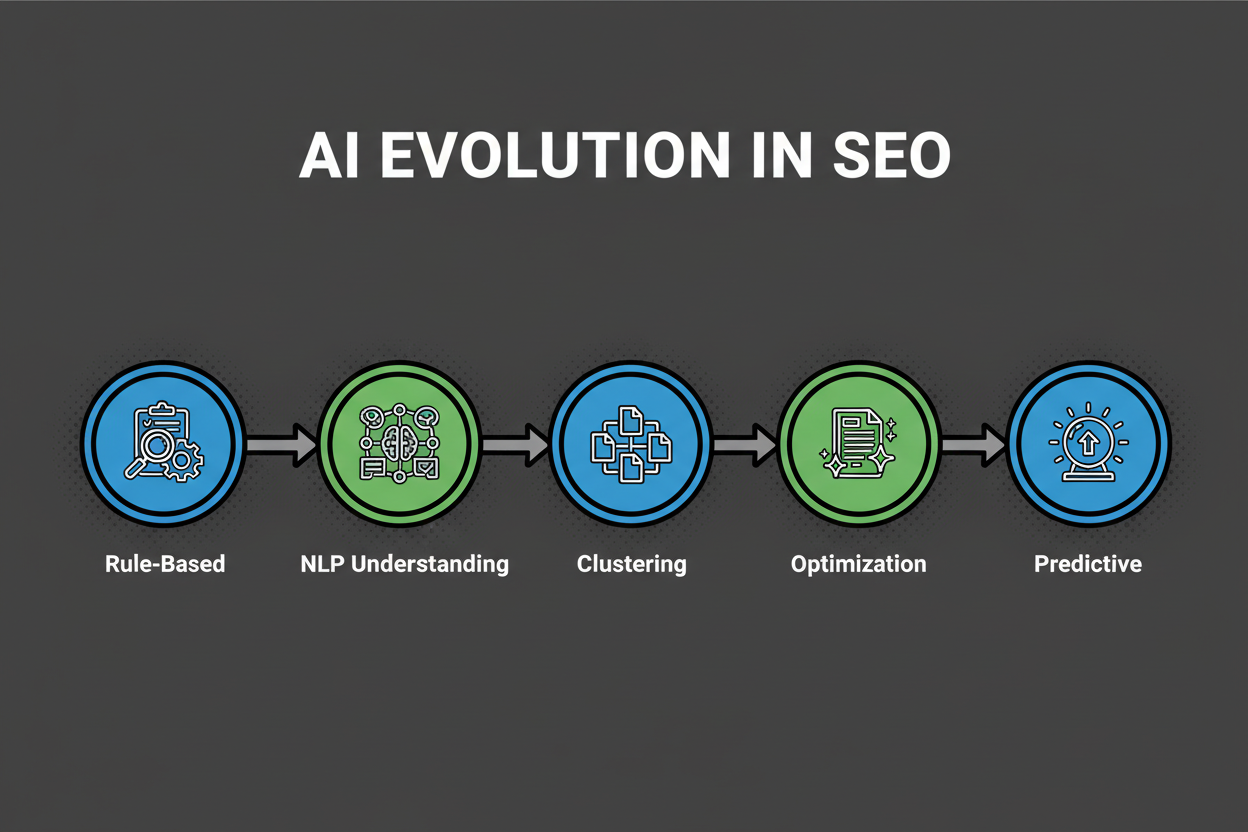
In this guide, you’ll learn how to turn AI into a practical ai seo strategy. We’ll map keywords into clusters, read the SERP with machines, spot content gaps, and wire up internal links programmatically. You’ll get step-by-step workflows, real examples, and troubleshooting tips so you can execute with confidence.
You’ll start by turning raw keyword chaos into structured, intent-led clusters that power a scalable content strategy.
Automated Keyword Clustering: Unlocking Smarter Content Strategies with AI
Automated keyword clustering is where ai seo optimization gets real. Instead of treating keywords as one-offs, you group them using SERP-similarity and semantic signals, then map them to intent. The result is a topical blueprint that tells you what to write, how deep to go, and how to interlink it for authority.
How does it work behind the scenes? AI evaluates SERP co-occurrence across top results to see which queries tend to rank together. It reads titles and H-tags to infer content types and angle. It extracts entities and relationships to understand topic scope. Some models even layer in link graphs to score authority clusters. Put simply, it uses what Google already rewards to shape your plan.
From keyword list to actionable clusters
- Collect broad and long-tail terms from multiple sources
- Normalize and de-duplicate; tag seeds, modifiers, entities
- Run SERP-similarity clustering with strict thresholds
- Split by intent (informational, commercial, transactional)
- Map clusters to hubs, spokes, and pillar priorities
- Assign primary/secondary terms; define canonical targets
- Validate against competitors; adjust to avoid cannibalization
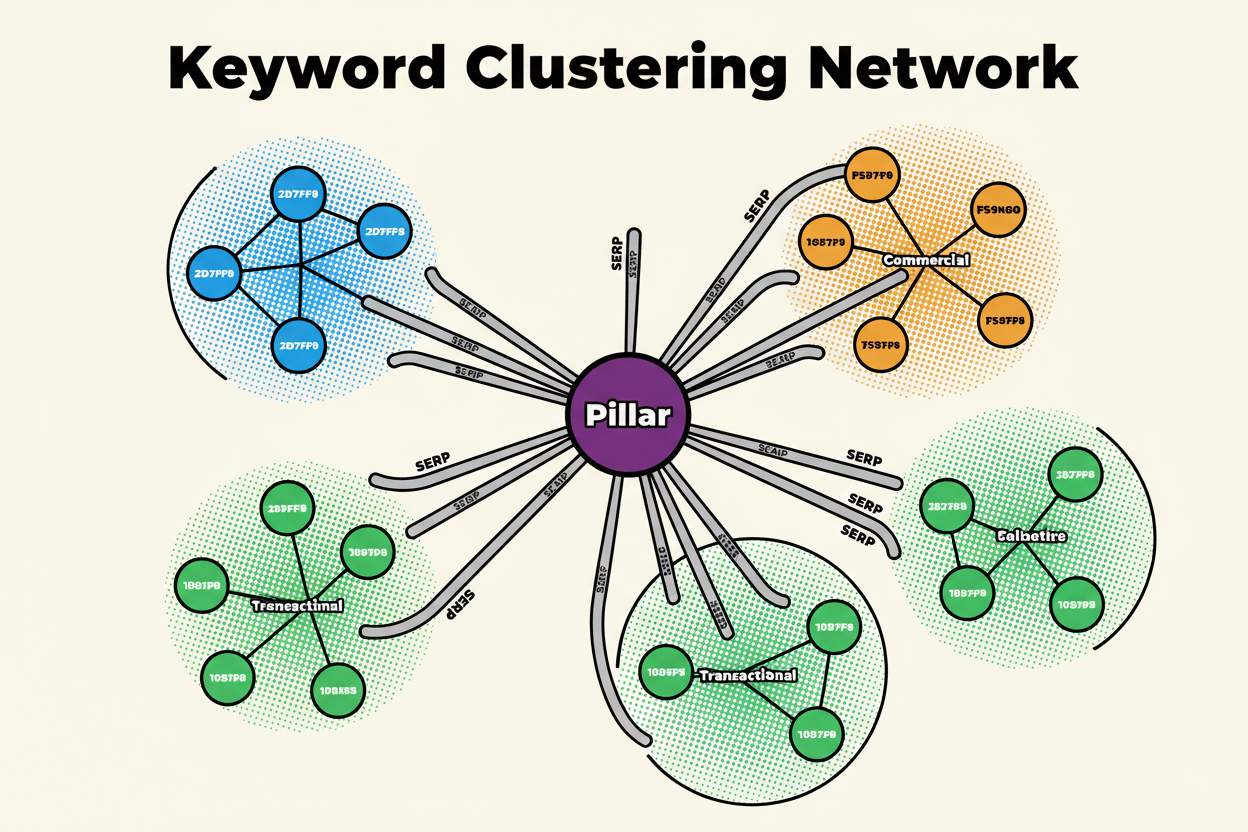
Let’s make it concrete. Say you’re competing in the AI CRM software niche. Your seeds include “ai crm,” “crm with ai,” “best ai crm,” “ai sales assistant crm,” “salesforce einstein alternatives,” and “hubspot ai vs salesforce.” You run automated keyword clustering and see a commercial cluster around “best ai crm,” “top ai crm tools,” “ai crm comparison,” and “ai crm reviews.” You map a pillar page for “Best AI CRM” with spokes for “AI CRM pricing,” “AI CRM features,” “AI CRM for small business,” and “Salesforce Einstein vs HubSpot AI.” Canonical targeting keeps the comparison content from competing with the pillar: the pillar targets “best ai crm,” while “einstein vs hubspot” targets “salesforce einstein vs hubspot ai” and links up to transfer relevance.
Why does this matter? Because clustered content wins breadth and depth together. Planning time can drop dramatically when you let tools auto-build clusters and outlines. Industry writeups cite reductions up to roughly 70% in content planning time when teams use AI to generate topical maps and editors surferseo.com. Case studies across e-commerce and SaaS report traffic lifts ranging from around 30% to multiple-thousand percent after implementing cluster-driven hubs and internal linking omnius.soxponent21.comeva.gururesearch.aimultiple.com. Some of these outcomes are vendor-reported, so use them as directional evidence and validate with your own baselines.
Here’s how the manual approach stacks up against AI when you have a big keyword set:
| Criterion | Manual Clustering | AI-Driven Clustering |
|---|---|---|
| Time to map 1,000 keywords | Days of spreadsheet work | Under an hour with SERP similarity |
| Intent accuracy | Inconsistent; subjective | Consistent; SERP-grounded |
| Coverage of long-tails | Partial | Extensive, auto-discovered |
| Cannibalization risk | Higher | Lower with canonical mapping |
| Update cadence | Rarely updated | Easily refreshed at scale |
One easy win is to watch for cannibalization early. If two pages chase the same cluster, consolidate under the stronger URL, set a canonical or redirect, and tighten internal links so authority flows to the chosen target. You’ll preserve equity and clarify relevance for search engines and users.
Once clusters are mapped, your next advantage comes from decoding the live SERP patterns that determine what actually ranks.
AI-Driven SERP Analysis: Decoding Search Intent and Ranking Factors
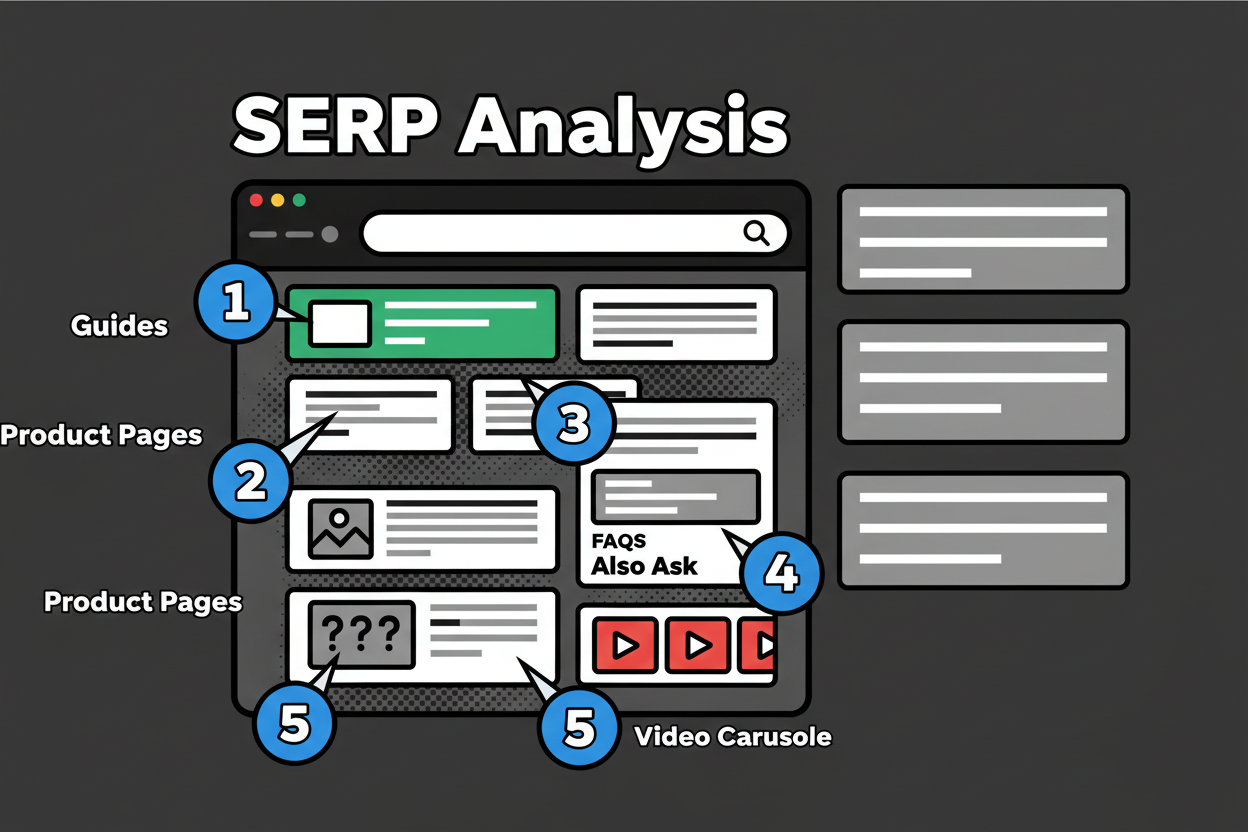
AI-driven SERP analysis takes your ai seo strategy from guesswork to pattern recognition at scale. You ingest organic results and every SERP feature in sight, then model what wins by content type and depth. Layer in entity extraction, headings and section structures, plus link and format signals. Finally, score patterns so you can predict which approach gives you the highest odds of ranking.
How to use AI for SEO optimization?
- Cluster keywords by SERP similarity and intent
- Analyze top results to model content type and depth
- Extract entities, questions, and sections that co-rank
- Identify feature gaps (FAQs, video, tables, tools)
- Benchmark on-page signals and internal links
- Prioritize opportunities by difficulty vs. potential
- Produce briefs and iterate with real user signals
Step 1: Pattern discovery
Start by mapping what the SERP rewards for each cluster. Are the winners comparison guides, tools, or product pages? Note recurring features like featured snippets, People Also Ask, videos, images, or site links. Pin down intent by what the top pages actually deliver, not by labels.
Step 2: Entity and structure extraction
Pull entities, synonyms, and related concepts from top results, then mirror the right coverage. Extract headings, section order, and FAQs to match user expectations while adding your unique value. Measure semantic alignment so your content tightly relates to the topic and entities that rank together, since higher semantic relevance correlates with ranking uplift searchatlas.com.
Step 3: Gap and threat analysis
Compare your page type and depth to the SERP’s dominant pattern. Identify feature gaps you can fill fast, like a missing FAQ section or a comparison table. Track competitors’ new launches and SERP feature wins to gauge threats and find openings where your page can beat them on intent satisfaction or format completeness competitiveintelligencealliance.io.
Step 4: Opportunity scoring and brief generation
Score each opportunity by a simple difficulty-versus-potential model. Then generate briefs that specify content type, priority entities, must-have sections, target SERP features, and internal links. Feed the brief to your writer and iterate using real user signals like dwell time and query refinements.
You’ve seen these plays work in the wild. Fugue moved from 10th to 1st by using Frase to uncover topic gaps and align content to what the SERP rewarded for its CSPM query set research.aimultiple.com. Flight Centre recorded a 26% traffic lift by running SearchPilot tests and optimizing high-value pages based on SERP-informed hypotheses research.aimultiple.com. STACK Media used BrightEdge insights to spot where to compete and saw meaningful traffic and ranking improvements for competitive health and fitness terms research.aimultiple.comresultfirst.com. Some of these results are vendor-reported or aggregated and should be validated against your own baselines.
One more reason to care about SERP leadership: it increases your odds of being cited in AI Overviews. Studies show that higher organic ranks have notably higher citation probability, with top positions far more likely to be referenced by AI summaries compared to lower ranks originality.aibeomniscient.com. In practice, optimizing for the dominant SERP pattern doesn’t just earn clicks, it improves your chances of being included in AI-generated snapshots too.
Now that you know what wins on the SERP, the fastest gains often come from filling the content gaps your competitors have left open.
Content Gap Discovery with AI: Finding and Filling Ranking Opportunities
Content gap discovery is the delta between your topical map and what the live SERP, competitors, and users actually demand. AI surfaces that delta by comparing your clusters and coverage with what ranks today. It highlights missing entities and subtopics, unanswered questions, and weak intent coverage within your site architecture.
Think of it as three layers working together. First is entity coverage: do your pages fully cover the entities, attributes, and relationships the SERP expects? Second is question clusters: which PAA questions and forum-like queries are co-ranking with your topic but absent on your page? Third is feature deficits: are you missing FAQs, comparison tables, video, or schema that show up consistently in winners? Tie these back to ai seo optimization so you prioritize gaps that move the needle, not just fill space.
Prioritize gaps with:
- Search demand vs. difficulty ratio
- Intent match for your funnel stage
- SERP feature potential (FAQ, snippet, video)
- Authority leverage (existing related hubs)
- Speed to publish and E-E-A-T readiness
- Internal link paths available
- Revenue or lead impact potential
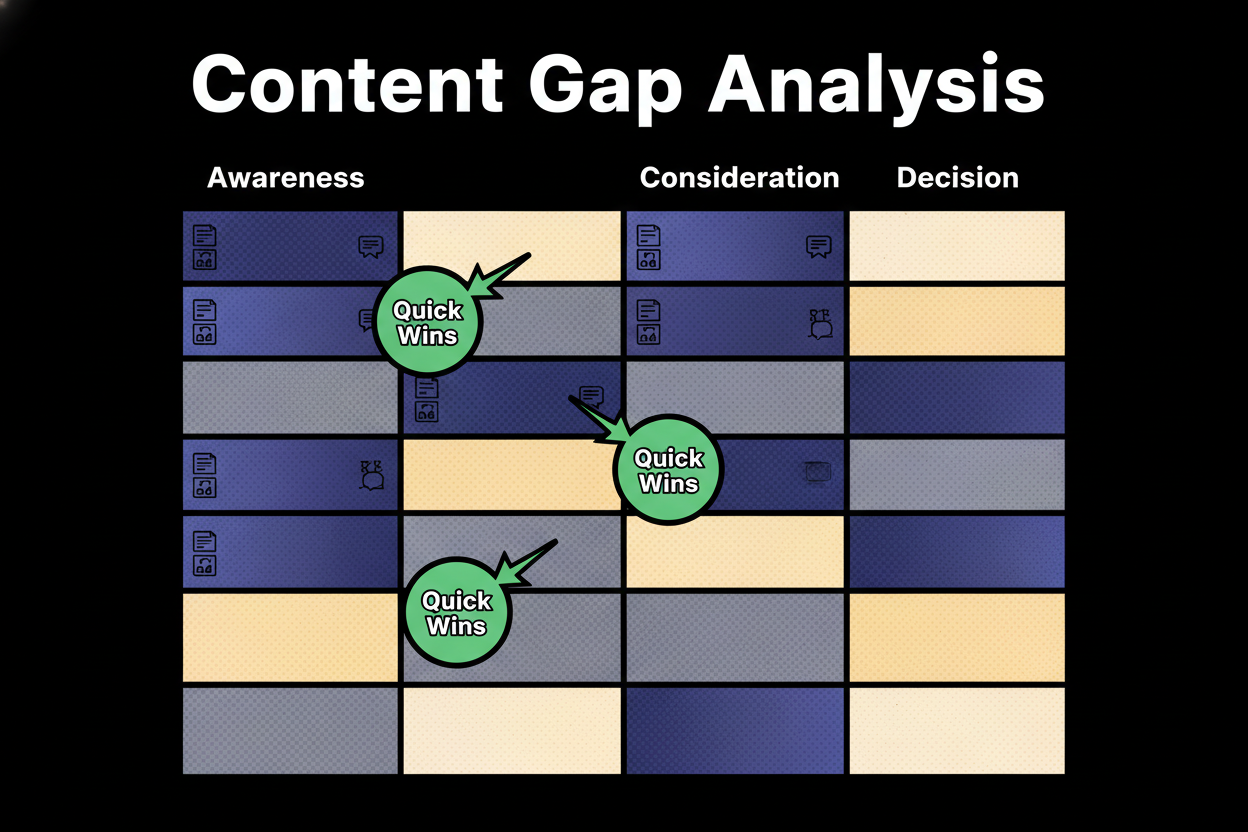
Here’s how it looks when it clicks. Fugue worked with Frase to identify missing topics and questions around its cloud security positioning, then rebuilt content to match real SERP expectations. That shift helped the target page rise from 10th to 1st, illustrating how gap-led content aligned to SERP patterns can unlock step-change visibility research.aimultiple.com.
For a bigger, architecture-level win, a B2B site supported by The Search Initiative reported more than 3,000% growth by aligning content with intent, expanding clustered coverage, and restructuring internal links around new hubs research.aimultiple.com. Treat this as directional because the metric is vendor-reported and may require validation, but the playbook remains solid: build the missing pillars and spokes that the SERP already rewards.
You can also correlate gap filling with structured data and semantic clarity. WordLift shows how adding structured data, tightening entity coverage, and refining content pieces can track with significant organic growth for a real estate site, including lifting a range of competitive terms wordlift.io. The theme is consistent: close the gaps the SERP exposes, then reinforce them with schema and strong internal links.
Turn your gap list into a calendar you can actually execute. Group gaps by cluster, then slot them into sprints: foundational pillars first, then high-intent spokes, then supporting FAQs and comparisons. Assign each brief a KPI set at the cluster level: coverage percentage, average position across the cluster, CTR, and assisted conversions. Track movement as a portfolio instead of judging posts in isolation.
Wire interlinking from day one. Each new page should link up to its pillar with descriptive anchors and receive links from sibling pages. Refresh older hubs to link down to new spokes so crawlers rediscover your updates quickly. Internal links can improve semantic relevance and help pass authority, which correlates with ranking lift when executed cleanly searchatlas.com.
Set a refresh cadence for volatile clusters. Re-crawl the SERP to see if formats or features shifted. If videos or FAQs suddenly dominate, update sections accordingly. Fold in zero-party signals like on-page engagement and search refinements to tune your briefs. Keep a living backlog so high-potential gaps never sit idle.
Last piece: quality gates. Route gap outputs through subject matter experts, add structured data where appropriate, and double-check sources before publishing. This helps you win both traditional snippets and AI Overviews, since clarity and authority raise your selection odds in both contexts beomniscient.com.
Bringing these techniques into your day-to-day workflow requires the right AI SEO tools and a clean integration plan.
Implementing AI SEO Tools: Best Practices, Pitfalls, and Expert Tips
Picking the right AI SEO tools starts with fit by use case. If your biggest wins will come from content optimization, choose an editor that reads the live SERP and scores entity coverage. If your bottleneck is research and tracking, look at suites that cluster at scale and pull competitive signals. Prioritize data quality and explainability so teams can trace a recommendation back to SERP patterns rather than a black box. Keep privacy and compliance front and center when you feed analytics or CRM data into models. And define clear roles across research, briefs, editing, QA, and publishing so accountability never gets fuzzy.
| Tool | Primary Use | Notable AI Capabilities | Integrations | Price Range | Best For |
|---|---|---|---|---|---|
| Surfer | Content optimization | SERP-based clustering, content editor, internal link suggestions | GDocs, WordPress | Mid | Content teams |
| Semrush | Research and tracking | Topic research, content ideas, AI writing assist | GA, GSC | Mid–High | Agencies |
| Ahrefs | Research and analysis | Keyword & SERP analytics, content gap insights | GSC | Mid–High | Technical SEOs |
| MarketMuse | Content strategy | Topic modeling, content briefs, inventory scoring | CMS APIs | High | Enterprise |
| Clearscope | Content optimization | NLP scoring, entity coverage guidance | GDocs | Mid–High | Editors |
| Frase | Briefs and Q&A | AI briefs, FAQ extraction, outline builder | GDocs, WP | Low–Mid | Lean teams |
| Screaming Frog (+AI add-ons) | Technical audits | Pattern detection, change detection, QA flows | GA, GSC | Low | Tech SEO |
| ContentKing | Monitoring | Real-time SEO change monitoring with AI alerts | CMS, GA | Mid | Large sites |
Wire tools into your CMS and analytics with discipline. Use version control for content briefs and drafts so every change is traceable. Add pre-publish QA gates for fact-checking, entity coverage, and internal links. Lock brand voice at scale with a lightweight policy: approved tone lines, entity lists, disallowed claims for sensitive topics, and canonical definitions for products and features. Align your AI outputs with GA and GSC by standardizing UTM rules, mapping cluster IDs into dashboards, and tracking page templates separately from one-off articles so you can see which content type actually wins.
AI SEO implementation checklist
- Define owners for research, briefs, QA, and publishing
- Set thresholds for clustering and SERP similarity
- Standardize briefs with entities, sections, and internal links
- Add pre-publish QA and fact-check gates
- Track cluster-level KPIs (coverage, CTR, rankings)
- Schedule content refresh cycles and link audits
- Review model outputs for bias and hallucinations When things wobble, look first at intent. If rankings drop after publishing, it’s often a misalignment between your content type and the SERP’s dominant pattern. For example, you shipped a product page into a SERP full of comparison guides. Fix it by recalibrating the brief to match the winning format, adding required entities and sections, and tightening internal links so authority flows into the correct canonical page. Re-check the SERP for feature gaps like FAQs or tables you can add quickly to regain relevance.
Measure ROI with a simple, durable framework. Baseline at the cluster level rather than single URLs. Track coverage, average position across the cluster, CTR, new sessions, and assisted conversions. Use holdouts or control groups when possible, especially for refresh tests. Attribute gains back to the technique by grouping pages into cohorts: AI-briefed new pages, AI-refreshed pages, and unchanged controls. Industry studies report sizable time savings from AI and a majority of teams seeing stronger ROI from AI-assisted workflows, but treat broad stats as directional and validate against your own baselines seoprofy.comsemrush.comsqmagazine.co.uk. As you measure, remember that higher organic rankings also raise the chance of being cited in AI Overviews, which can compound visibility over time originality.aibeomniscient.com. Some ROI figures in public case studies are vendor-reported and require validation before you use them for forecasting research.aimultiple.comresultfirst.com.
Even with strong processes, teams ask smart questions about limits, ROI, and ethics. Let’s address them directly.
Frequently Asked Questions: Advanced AI SEO Optimization
Q: Is AI-generated content safe for SEO, or will it trigger penalties? A: It’s safe when you ship quality, accurate, people-first content. AI can help you draft and structure, but you still need human editing, fact checks, and clear E-E-A-T signals. Many teams already use AI to accelerate research and outlines, reporting real efficiency gains without penalties when quality controls are in place seoprofy.comsemrush.com. Studies also note that AI-written pages appear in a meaningful slice of top results, which suggests Google rewards usefulness, not the tool you used to write semrush.com. Keep a human in the loop, especially for YMYL.
Q: Which AI SEO tools are best, and when should I use them? A: Use Surfer or Clearscope for entity coverage and content editors, Frase for briefs and FAQ extraction, and MarketMuse for topic modeling and content inventory scoring. Reach for Semrush or Ahrefs when you need wide research, SERP analysis, and tracking. Add Screaming Frog and ContentKing for technical audits and monitoring. Pair tools to your workflow gap: briefs and editing for content velocity, research suites for competitive visibility, and monitoring for site-wide hygiene research.aimultiple.com.
Q: How do I measure the ROI of ai seo optimization? A: Measure at the cluster level. Establish a baseline for coverage, average rank, CTR, and conversions. Launch AI-briefed pages or refreshes as a cohort. Keep a holdout group to isolate impact. Quantify time saved on research and outlines as a cost reduction, then tie traffic and conversion lifts to revenue. Industry benchmarks report majority ROI improvements from AI in content workflows, but validate with your own data and attribution models semrush.comsqmagazine.co.uk.
Q: My rankings dropped after using AI. How do I diagnose the cause? A: Start with the SERP. Check if your content type matches the dominant pattern. If winners are list guides with comparison tables and your page is a thin product page, re-brief to the correct format. Confirm entity coverage and fill feature gaps like FAQs. Audit internal links to ensure the right page is canonical for the cluster. Teams that use AI to analyze SERP patterns and run structured tests often recover quickly because they find the precise mismatch to fix research.aimultiple.com.
Q: How do I maintain brand voice and accuracy at scale while using AI? A: Set a voice and entity policy that lives in every brief: tone expectations, approved claims, and must-use terms. Require editor and SME review. Add QA gates for facts and compliance. WordLift’s work shows how structured data and entity clarity can lift performance while keeping content consistent and trustworthy wordlift.io. Most teams report editing AI outputs before publishing, which aligns with best practice seoprofy.com.
Q: How should I optimize for AI Overviews and featured snippets? A: Aim to win the underlying SERP first. Higher ranks correlate with higher citation probability in AI Overviews, so your top goal is still traditional ranking lift originality.aibeomniscient.com. Structure content with succinct definitions, step lists, FAQs, and schema to match how AI and snippets extract answers. Cover entities thoroughly and keep claims clear and sourced. Track both rankings and AI Overview citations in your reporting.
Q: Can AI replace human SEO expertise? A: No. AI accelerates research, clustering, and briefs, but strategy, editorial judgment, and quality control remain human strengths. The best outcomes combine AI speed with human oversight, and many teams report the biggest gains when they work this way seoprofy.comsqmagazine.co.uk.
{
"@context": "<https://schema.org>",
"@type": "FAQPage",
"mainEntity": [
{
"@type": "Question",
"name": "Is AI-generated content safe for SEO, or will it trigger penalties?",
"acceptedAnswer": {
"@type": "Answer",
"text": "AI is safe when content is accurate, helpful, and reviewed by humans. Many teams use AI for research and outlines and report efficiency gains without penalties when quality controls and E-E-A-T are maintained."
}
},
{
"@type": "Question",
"name": "Which AI SEO tools are best, and when should I use them?",
"acceptedAnswer": {
"@type": "Answer",
"text": "Use editors like Surfer or Clearscope for entity coverage, Frase for briefs and FAQs, MarketMuse for topic modeling, and Semrush or Ahrefs for research and tracking. Add Screaming Frog and ContentKing for audits and monitoring."
}
},
{
"@type": "Question",
"name": "How do I measure the ROI of AI-driven SEO?",
"acceptedAnswer": {
"@type": "Answer",
"text": "Measure at the cluster level with baselines for coverage, rank, CTR, and conversions. Launch AI-briefed pages as cohorts, keep holdouts, quantify time saved, and attribute revenue impact to the technique rather than single URLs."
}
},
{
"@type": "Question",
"name": "My rankings dropped after using AI. How do I diagnose?",
"acceptedAnswer": {
"@type": "Answer",
"text": "Check SERP intent and format first. Re-brief to match the dominant pattern, add missing entities and features, and correct internal links so the right canonical page carries authority."
}
},
{
"@type": "Question",
"name": "How do I maintain brand voice and accuracy at scale with AI?",
"acceptedAnswer": {
"@type": "Answer",
"text": "Create a voice and entity policy in every brief, require editor and SME review, and add QA gates for facts and compliance. Use structured data to reinforce clarity and trust."
}
},
{
"@type": "Question",
"name": "How should I optimize for AI Overviews and featured snippets?",
"acceptedAnswer": {
"@type": "Answer",
"text": "Win the underlying SERP first, since higher ranks are more likely to be cited. Structure content with clear answers, FAQs, and schema to increase selection odds for both snippets and AI Overviews."
}
},
{
"@type": "Question",
"name": "Can AI replace human SEO expertise?",
"acceptedAnswer": {
"@type": "Answer",
"text": "No. AI boosts speed and scale, but strategy, editorial judgment, and quality assurance require human expertise. The strongest results come from a combined workflow."
}
}
]
}
Armed with answers, you can craft a durable plan that compounds results over time.
Conclusion: Building a Future-Proof AI SEO Strategy
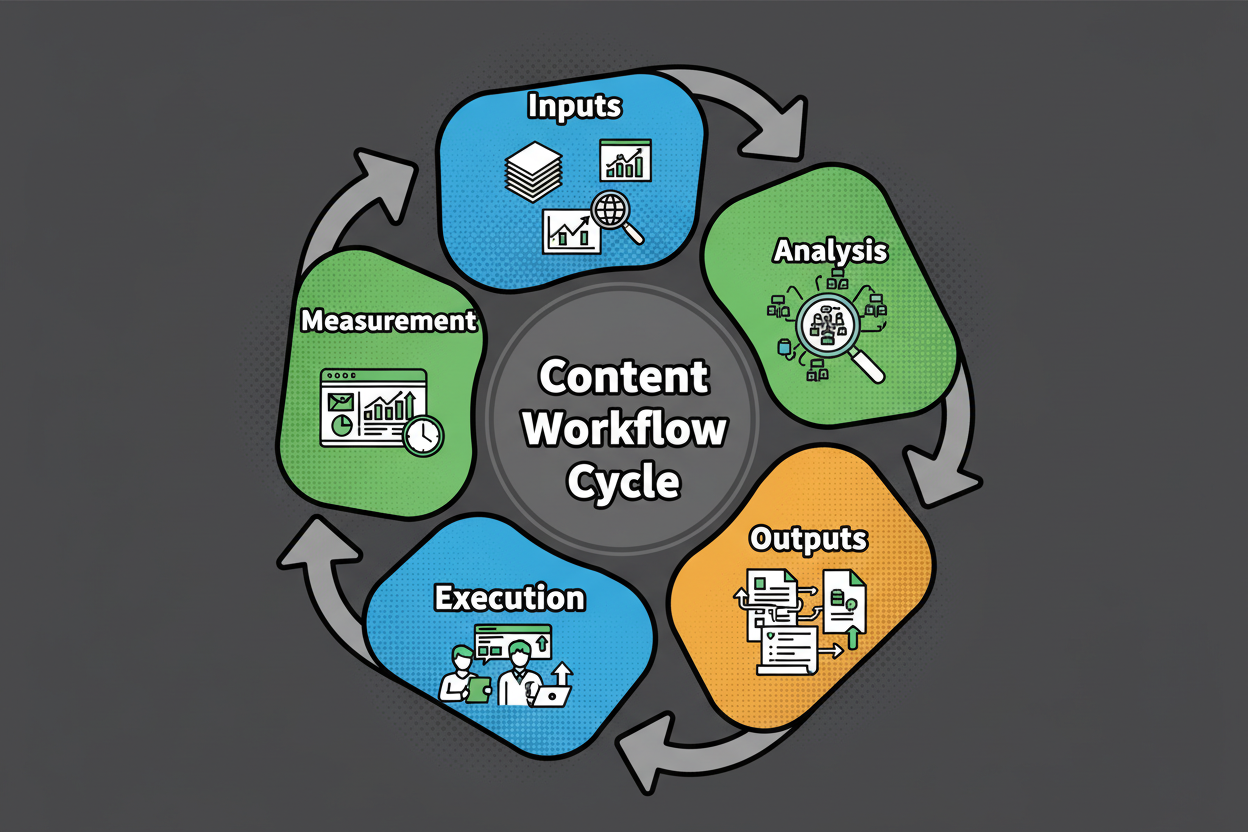
Here’s your big picture. Automated clustering turns chaos into a clean topical map. AI-driven SERP analysis shows you what actually wins and why. Content gap discovery points to pages you should build next, not someday. And a disciplined tool stack ties the loop together so measurement guides your next sprint. That’s ai seo optimization working end to end.
| Technique | What it does | Primary metrics moved | Key risk to manage | Example tools |
|---|---|---|---|---|
| Automated keyword clustering | Maps topics and intent | Coverage, rankings, CTR | Cannibalization | Surfer, Semrush |
| AI-driven SERP analysis | Models content types and features | Snippet wins, CTR, time-to-rank | Misreading intent | Ahrefs, Frase |
| Content gap discovery | Targets missed demand | New sessions, depth | Thin content | MarketMuse, Clearscope |
| Programmatic internal linking | Distributes authority | Crawlability, dwell | Overlinking | Screaming Frog |
| AI briefs and entity optimization | Improves relevance | E-E-A-T signals, quality | Hallucinations | Clearscope, Frase |
| Predictive performance modeling | Guides priorities | ROI, velocity | Overfitting | In-house, BI stack |
Start small and focused. Pick one high-potential cluster, run a SERP pattern read, and ship a pillar with three spokes. Add schema, tune internal links, and measure movement as a cohort. If the pattern holds, scale to your next cluster. If not, iterate the brief and format until it aligns with what the SERP rewards.
Prioritize, pilot, measure, iterate. That rhythm is how you turn AI from shiny object into an advantage that compounds.
{
"@context": "<https://schema.org>",
"@type": "Article",
"headline": "The Ultimate Guide to Advanced AI SEO Optimization Techniques for Higher Rankings",
"description": "Discover advanced AI SEO optimization techniques, including automated keyword clustering, AI-driven SERP analysis, and content gap discovery. Outperform competitors with actionable, evergreen strategies.",
"mainEntityOfPage": {
"@type": "WebPage",
"@id": "<https://yourdomain.com/blog/advanced-ai-seo-optimization-techniques>"
},
"inLanguage": "en",
"wordCount": "2500",
"articleSection": [
"Introduction",
"Automated Keyword Clustering",
"AI-Driven SERP Analysis",
"Content Gap Discovery",
"Implementing AI SEO Tools",
"Frequently Asked Questions",
"Conclusion"
],
"keywords": [
"ai seo optimization",
"ai seo strategy",
"ai seo tools",
"serp analysis",
"content gap analysis",
"ai-driven seo"
],
"author": {
"@type": "Organization",
"name": "Your Brand"
},
"publisher": {
"@type": "Organization",
"name": "Your Brand",
"logo": {
"@type": "ImageObject",
"url": "<https://yourdomain.com/logo.png>"
}
}
}